Click to compare the two versions side-by-side
NAPFA Genesis members and friends, thank you for participating in my recent webinar about writing effective emails! I have two things for you in this post.
- An example, with practical tips, of how to rewrite an email contributed by one of your NAPFA colleagues.
- A listing of the top lessons that you and your colleagues learned from my webinar. Scroll to the bottom of this post, if this is what you want to read.
Email critique: The original, unedited version
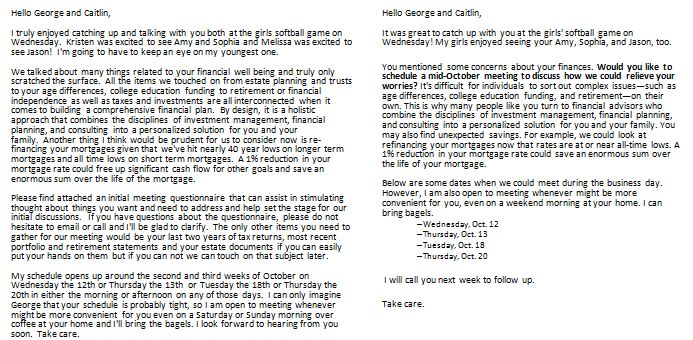
Here is the original email. Names have been changed to protect privacy.
Hello George and Caitlin,
I truly enjoyed catching up and talking with you both at the girls softball game on Wednesday. Kristen was excited to see Amy and Sophia and Melissa was excited to see Jason! I’m going to have to keep an eye on my youngest one.
We talked about many things related to your financial well being and truly only scratched the surface. All the items we touched on from estate planning and trusts to your age differences, college education funding to retirement or financial independence as well as taxes and investments are all interconnected when it comes to building a comprehensive financial plan. By design, it is a holistic approach that combines the disciplines of investment management, financial planning, and consulting into a personalized solution for you and your family. Another thing I think would be prudent for us to consider now is re-financing your mortgages given that we’ve hit nearly 40 year lows on longer term mortgages and all time lows on short term mortgages. A 1% reduction in your mortgage rate could free up significant cash flow for other goals and save an enormous sum over the life of the mortgage.
Please find attached an initial meeting questionnaire that can assist in stimulating thought about things you want and need to address and help set the stage for our initial discussions. If you have questions about the questionnaire, please do not hesitate to email or call and I’ll be glad to clarify. The only other items you need to gather for our meeting would be your last two years of tax returns, most recent portfolio and retirement statements and your estate documents if you can easily put your hands on them but if you can not we can touch on that subject later.
My schedule opens up around the second and third weeks of October on Wednesday the 12th or Thursday the 13th or Tuesday the 18th or Thursday the 20th in either the morning or afternoon on any of those days. I can only imagine George that your schedule is probably tight, so I am open to meeting whenever might be more convenient for you even on a Saturday or Sunday morning over coffee at your home and I’ll bring the bagels. I look forward to hearing from you soon. Take care.
Email critique: Revised email
Hello George and Caitlin,
It was great to catch up with you at the girls’ softball game on Wednesday! My girls enjoyed seeing your Amy, Sophia, and Jason, too.
You mentioned some concerns about your finances. Would you like to schedule a mid-October meeting to discuss how we could relieve your worries? It’s difficult for individuals to sort out complex issues—such as age differences, college education funding, and retirement—on their own. This is why many people like you turn to financial advisors who combine the disciplines of investment management, financial planning, and consulting into a personalized solution for you and your family. You may also find unexpected savings. For example, we could look at refinancing your mortgages now that rates are at or near all‑time lows. A 1% reduction in your mortgage rate could save an enormous sum over the life of your mortgage.
Below are some dates when we could meet during the business day. However, I am also open to meeting whenever it might be more convenient for you, even on a weekend morning at your home. I can bring bagels.
- Wednesday, Oct. 12
- Thursday, Oct. 13
- Tuesday, Oct. 18
- Thursday, Oct. 20
I will call you next week to follow up.
Take care.
My comments on the original and revised emails
STRENGTHS OF THE DRAFT EMAIL
I like that the email writer
- Emphasized where he knows the recipients from and showed that he knows their children’s names
- Showed knowledge of the recipients’ specific challenges
- Suggested how he might save money for the recipients
- Suggested specific dates for a meeting
- Showed flexibility about when to meet with the recipients
SUGGESTIONS
- Streamline the polite social chat, so you can hit the action item quickly. For example, naming the recipients’ children is more important than naming your own.
- Put the action item at the top of your email, immediately after your streamlined social chat.
- Emphasize the WIIFM—What’s In It For Me—for your email recipient.
- Shorten sentences.
- Don’t overwhelm the reader with information. I fear the readers may feel overwhelmed by receiving the new client questionnaire. Send it after they make an appointment.
- You’ll have a higher success rate over the long haul if you call to follow up than if you wait for your readers to call you.
- Keep your emails as short as possible. My changes cut the email from 388 words to only 211.
Your top lessons from my email webinar
In response to my question, “What’s the most important lesson you learned today?” you typed the following lines into the GoToMeeting question box or in your email to me.
Consider inputting this link into your calendar, with a reminder to check one month from now to see if you’ve improved your emails.
- The best item I learned was how to simplify what I am writing. As a detail-oriented person it is not easy to leave out details, but they may be unnecessary! This is something I will work to improve on.
- What I learned – Use fewer words per sentence and write shorter paragraphs. Use simple language.
- get rid of the “to be” verbs!
- Firm name in subject line and email signatures. Thanks!
- Good tip on self-editing to be more concise.
- What I learned: keep it simple, straightforward, and focused on the reader’s interests
- Importance of short and direct emails
- What I learned – you start losing your audience at 42 words per paragraph, 14 words per sentence and 2 syllables per word.
- Do not assume what is important to you, as the advisor, is the same thing that is important to the reader. Narrow your importance and simplify the message.
- WIIFM, 14 14 2
- Lessons learned: Thinking about WIIFM is an important lesson to consider. I usually understand what I want out of the client, but typically fail to think of how the request will be received and perceived. I also like the idea of [Sorry, this answer was cut off]
- Learned great tips about simplifying sentences
- My best take away was keeping Paragraphs and Sentences short. Also the words not to use.