Tag Archive for: grammar

Do your grammar, punctuation, and usage affect your credibility?

Does the quality of your writing matter? It looks like it does. When I asked “Does a writer’s grammar, punctuation, or usage errors damage that writer’s credibility in your eyes?”, an amazing 100% of respondents said “yes” in response to the survey on my blog and in my newsletter.

Specifically, they gave the following answers to my multiple-choice question.

0%   No, I don’t notice errors
0%   No, I don’t care
26% Yes, but I forgive small mistakes, especially in social media posts
74% Yes, they damage the writer’s credibility

I imagine that my readers are more critical than the general population. Still, these numbers should make all of us, including me, pay closer attention to how we write.

Respondent comments on bad writing

As one respondent commented, “Having your reading disrupted by a misspelled word or badly written sentence is like having air suddenly let out of a balloon. It makes me question the writer as well as the content.” Another reader said, “it reflects poorly on the writer and shows lack of attention to detail.” On a similar note, one person wrote, “There’s always that nagging feeling: if they didn’t care enough to proofread this, where else are they cutting corners? I try to be charitable because I too make mistakes, but it really bugs me.”

In their comments, readers showed some tolerance for mistakes. Here’s one example, “To me, it shows the writer is not detailed enough to review their input before hitting ‘go’ – drives me crazy. That being said, I hit the wrong key often when texting and sometimes miss it before sending, so I have a small tolerance for those sort of errors.”

Believe it or not, despite concerns about writing mistakes, I fall into the 26% of people who tolerate small mistakes, especially in social media.

The worst mistakes?

The second question in my survey asked, “What is the worst mistake that writers make? Why is this mistake bad?”

Popular answers included spelling mistakes, mistakenly using “it’s” as the possessive form of “it,” and failing to proofread.

Here are more answers to my question about the worst mistakes:

“It’s a toss-up between thinking they are texting and using texting acronyms and overloading their writing with technical jargon.”

“Writing with very little thought and planning… poor sequencing of ideas, incomplete sentences, stream of consciousness, no clear call to action. When that’s the output, why bother?”

“Since I read almost no fiction–in my job, I don’t have to because what I see and hear no writer could make up–I confine my comment to non-fiction. Embedding numbers inside paragraphs abuses most readers because it asks them to ‘see’ relationships between and among numbers that can be shown much more easily with charts and graphs.”

“Using too many words. I want to get the point, learn the lesson without reading useless words.”

Dave Spaulding on writing mistakes

I’m not the only person raising these questions in the world of investment management. You can read Dave Spaulding’s “Should GIPS verifiers correct grammar? Spelling?

When Dave sees mistakes, he recommends changes. In his blog post, he says, “On occasion, I’ve discussed this with our clients, and in every case the client has been very clear that they welcome my comments. Most want their materials to be as correct in all respects as possible.” That’s good news.


March 13, 2017 update: The original version of this post linked to my original survey. I updated the post to focus on the survey results, which I’d published in my newsletter.

Jan. 22, 2025: I made minor updates.

SEPT. NEWSLETTER: Advice from a powerful book agent

Success requires passion

To write a best-selling book, write about a topic you’re passionate about, advised agent Suzanne Gluck on the podcast  “People I (Mostly) Admire,” episode #10. Gluck has represented almost 200 books on the New York Times bestseller lists.

Passion alone isn’t enough to create a bestseller. But without it, you’re unlikely to succeed, Gluck said.

Write better investment one-pagers

In “About Those One-Pagers,”  Tom Brakke of The Investment Ecosystem says:

Most asset managers fail the test of communicating the essence of who they are in their one-pagers — theirs looks the same as all the others, so the reader naturally gravitates to the performance information, resulting in a wasted opportunity to tell their unique story.

Brakke suggests, due to the rise of machine analysis and artificial intelligence (AI), investment managers should stop arbitrarily limiting their information to one page. Instead, “Tell the story of who the manager is in a way that prizes brevity but not at the cost of quality in content and design.” I like this idea.

Rules for effective AI prompts

How can you create effective prompts for generative AI?

The Nielsen Norman Group recommends using a CARE—context, ask, rules, examples—framework. Learn more in “CARE: Structure for Crafting AI Prompts.”

For fans of the em dash

Lately, some sources have suggested that the use of em dashes suggests that something was written using generative AI.

Many writers disagree.

McSweeney’s is fighting back with a humorous essay, “The Em Dash Responds to the AI Allegations” by Greg Mania. I’m a big fan of a well-placed em dash, so this essay made me smile. I hope you enjoy it too.

Here’s an old post of mine on em dashes versus en dashes.

Bulgur salad

A bulgur salad is easy to make and works great for picnics during the summer. I recently made this “Bulgur Salad with Fruits and Nuts” by VegKitchen. I like that it’s made with ingredients that I often have at hand.

I love my roses

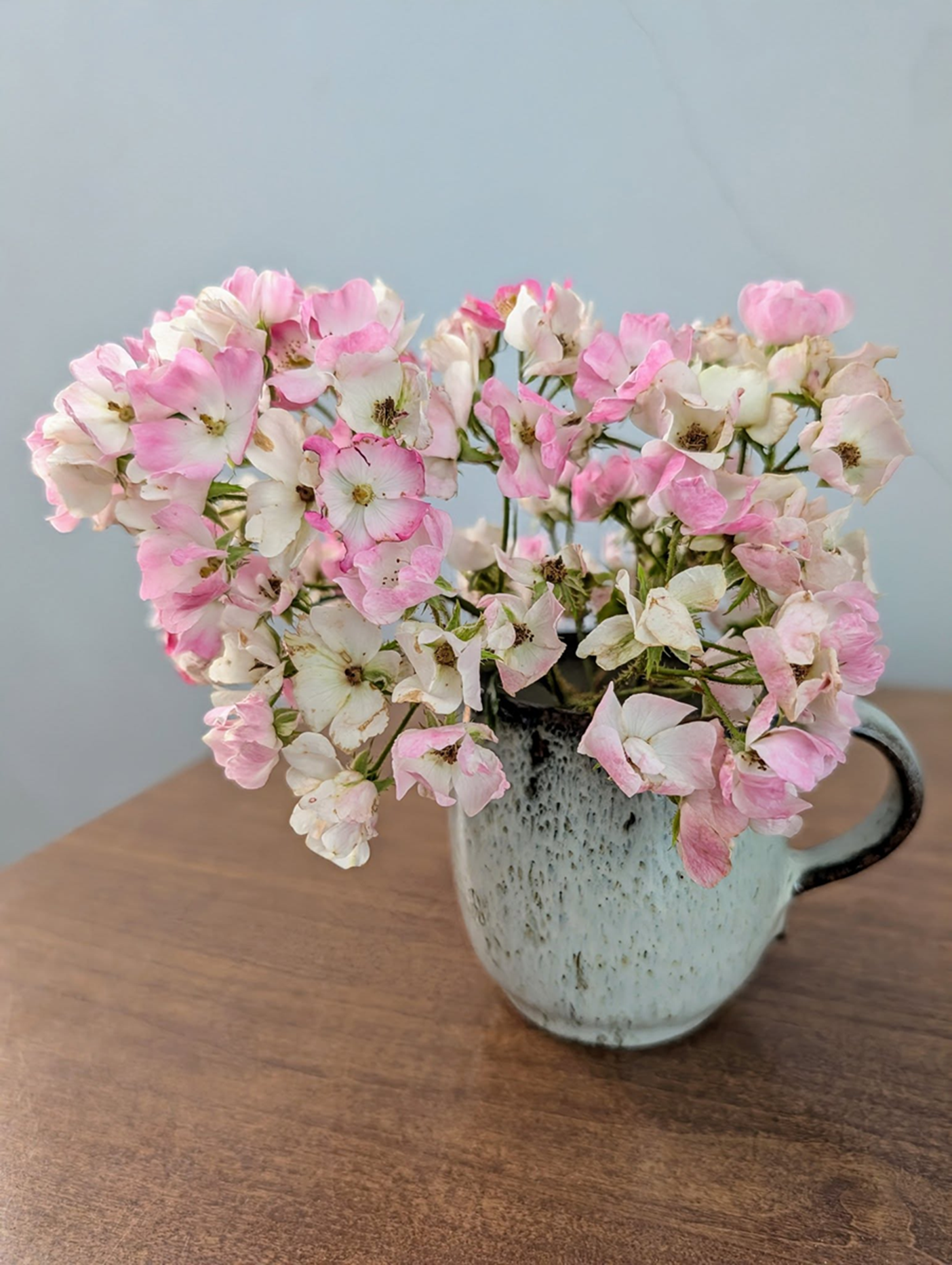
Here’s a photo of my ballerina roses in a Japanese mug.Ballerina roses in a Japanese mug


What my clients say about me

“Fast, effective, insightful. I can think of no better resource for superior financial writing.”

“Susan has an exceptional ability to tailor investment communications to the sophistication level of any audience. She has an uncanny ability to make very complex investment and/or economic topics accessible and understandable to anyone.”

“Susan’s particularly good at working through highly technical material very quickly. That’s very important in this business. A lot of people are good writers, but they have an extensive learning curve for something they’re unfamiliar with. Susan was able to jump very quickly into technical material.”

Read more testimonials!


Improve your investment commentary

Attract more clients, prospects, and referral sources by improving your investment commentary with 44 pages of the best tips from the InvestmentWriting.com blog.

Tips include how to organize your thoughts, edit for the “big picture,” edit line by line, and get more mileage out of your commentary.

Available in PDF format for only $9.99. Email me to buy it now!


Boost your blogging now!

Financial Blogging: How to Write Powerful Posts That Attract Clients is available for purchase as a PDF ($39) or a paperback ($49, affiliate link).


“All” versus “all of”

I’m a little obsessive about proper usage, but there are plenty of holes in my knowledge of writing style. Thus, when I saw “all our funds,” it drove me to the internet to see if that should read “all of our funds.” My first observation: this seems to be a question mainly for English language learners. There don’t appear to be many established grammar or style gurus writing online about this topic.

Use “all of” only with pronouns, says Grammar Monster

Grammar Monster says to use “all”—instead of “all of”—before any noun except a pronoun. For example, “all of us,” but “all the cheese.” In a sidebar, it says that “all of” is an indefinite pronoun, but “all” is an “indefinite adjective.” How’s that for a bit of grammar trivia?

Garner’s agrees

Although I follow Grammar Monster on Twitter, the site isn’t one of my regular go-to resources. So, I delved into my trusty Garner’s Modern American Usage. Garner says that “all” is more formal than “all of.” He says one should use “all of” only before a pronoun—agreeing with Grammar Monster—or when a possessive noun follows, as in “Beyond all of Jones’ ego-stroking maneuvers.”

That’s all for now on my latest research.


Note: This post was updated on July 12, 2024.

Singular or plural–which is right for $5 million?

It’s not always easy to tell whether a noun is singular or plural. Take this example “$5 million was/were enough.”

When I informally polled some writer friends, four out of five voted for “was.” That sounds right to me, too.

The word “dollars” is plural, but “$5 million” becomes what grammarians call a collective noun.

Think of it this way, a portfolio management team is made up of people, but the team is a single entity so you say “The team was” instead of “The team were.”

On collective nouns, a Grammar Girl blog post written by Bonnie Trenga (but no longer available online) said the following:

Inanimate objects, such as “sugar” or “furniture,” are called mass nouns or uncountable nouns, and are always singular. So you would say, “This sugar is very sweet” or “My furniture is too old.” You can’t say, “This sugar are” or “My furniture are.” If you want to talk about individual grains of sugar or individual pieces of furniture, then you have to say something like “Eight grains of sugar were found” or “These pieces of furniture are new.”

However, as one of my friends and the Grammar Girl blog pointed out, the British treat collective nouns differently. They combine them with plural verbs. No wonder some of us are confused!

Image courtesy of Stuart Miles / FreeDigitalPhotos.net


Note: This post was updated on Nov. 30, 2023.

Use a comma between consecutive adjectives?

When two consecutive adjectives modify the same noun, you’re supposed to put a comma between them. I sometimes struggle to decide if that’s appropriate. After all, there are cases when the first adjective modifies the second, as in “pale blue paper.”

So I was delighted to find this advice from Jan Venolia in Write Right!:

One way to determine whether adjectives modify the same noun (a young, energetic student) is to insert the word and between the adjectives. “Young and energetic student” makes sense. … Use a comma between adjectives only if and would be a plausible alternative.

I must bookmark this post for the next time I struggle with this issue. I hope this tip helps you, too.

To learn more about when to use a comma between consecutive adjectives, read the Grammar Girl blog’s post on “Commas with Adjectives.” The post goes into the details of coordinate adjectives versus cumulative adjectives. Those are two terms I never heard of before.


Disclosure: If you click on an Amazon link in this post and then buy something, I will receive a small commission. I provide links to books only when I believe they have value for my readers.


“In order to” versus “to”

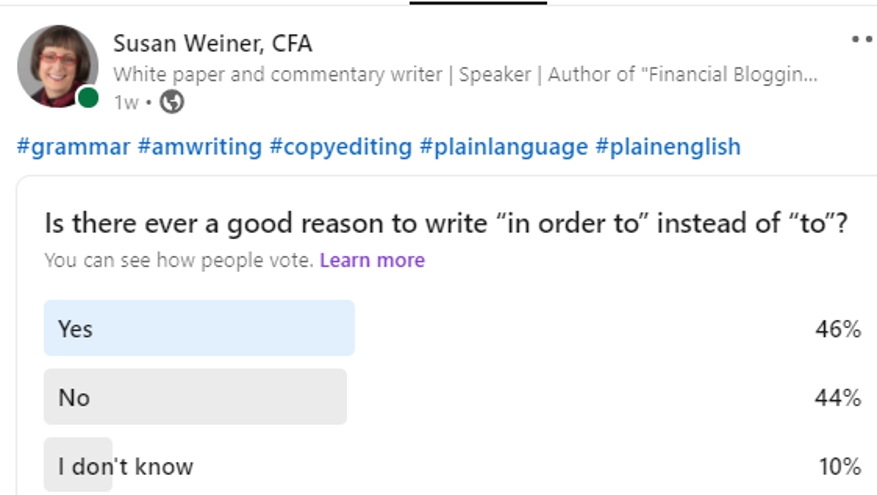
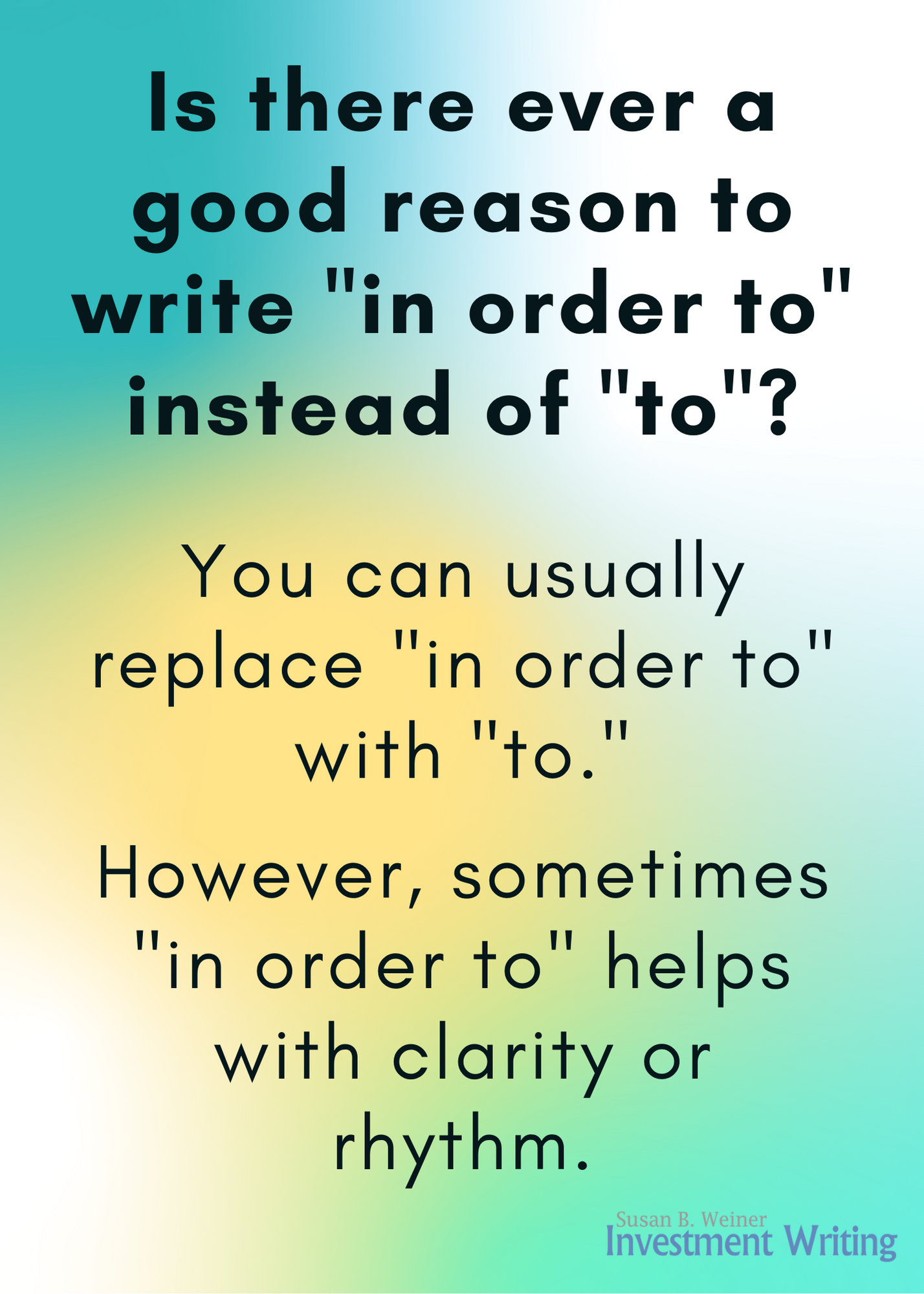
Is there ever a good reason to write “in order to” instead of “to”? When I posted this poll on LinkedIn, I expected the answer to be “no.” However, I did some research and was surprised by the results.

in order to vs to image

Go with “to” most of the time

Generally, it’s better to write “to” than “in order to.”

Shorter sentences are typically easier to understand. That’s why I’ve devoted many words to suggesting how you can make your writing more concise. In fact, that’s a focus of my investment commentary webinar. I’ve given many examples of how to shorten your writing in “Word and phrase substitutions for economical writers.”

As the Doris & Bertie website says: “‘In order to’ isn’t more precise. It doesn’t provide any extra meaning – just extra wordage for your reader to trawl through to get to the important words in the sentence.”

However, there are exceptions to the rule of shorter is better.


Clarity may require “in order to”

In rare cases, “in order to” must be used for clarity. Here’s an example I found in Amy Einsohn’s The Copyeditor’s Handbook:

CLEAR: “Congress modified the administration’s proposal in order to exempt small businesses.”

UNCLEAR: “Congress modified the administration’s proposal to exempt small businesses.”

In the first sentence, it’s clear that Congress acted to exempt small businesses. The second sentence could mean that. Or, it could mean that the administration wanted to exempt small businesses and Congress acted against that.

Rhythm may benefit from “in order to”

Sometimes a sentence just sounds better with the addition of “in order to.” In response to my LinkedIn poll, Paul Bobnak gave me this example from the preamble to the U.S. constitution:

We the People of the United States, in Order to form a more perfect Union, establish Justice, insure domestic Tranquility, provide for the common defense, promote the general Welfare, and secure the Blessings of Liberty to ourselves and our Posterity, do ordain and establish this Constitution for the United States of America.

What will YOU do?

Will you adjust your use of “in order to” after reading this post?

I will continue to ruthlessly trim most instances of “in order to” from my clients’ writing, and I will sometimes leave them in place.


Disclosure: If you click on an Amazon link in this post and then buy something, I will receive a small commission. I provide links to books only when I believe they have value for my readers.


So at the start of a sentence

I am far from perfect in my knowledge of grammar, as I admitted in “Confessions of a grammar ignoramus.” So I wasn’t surprised to learn that I’ve been making a mistake when starting a sentence with “so.” Apparently, I shouldn’t have been putting a comma after “so” at the beginning of a sentence.

No comma

So is a good word for beginning a sentence,” says Garner’s Modern American Usage because “The shorter word affords a brisker pace” compared with words such as “however,” “additionally,” or “therefore.” Garner doesn’t specifically opine on whether to use a comma, but none of his examples use one.

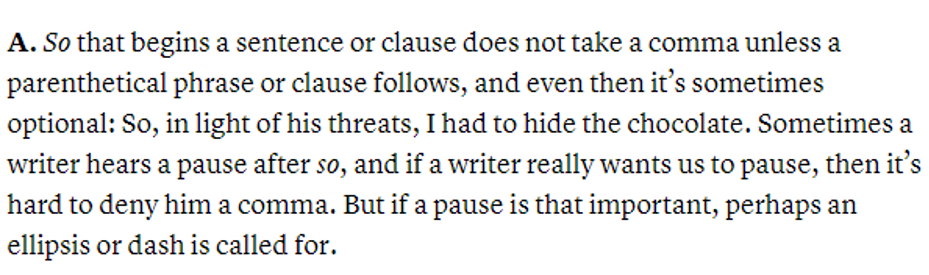
The Chicago Manual of Style calls for not using a comma in most cases when “so” begins a sentence. Please note its explanation of exceptions to this rule.

chicago manual of style on so at the start of a sentence

Use comma

If you believe in using a comma after an initial “so,” you have some support. It’s a conjunctive adverb, so it must be followed by a comma, says Syelle Graves, in a guest post on “Is Starting a Sentence with ‘So’ Condescending?” on the Grammar Girl blog.

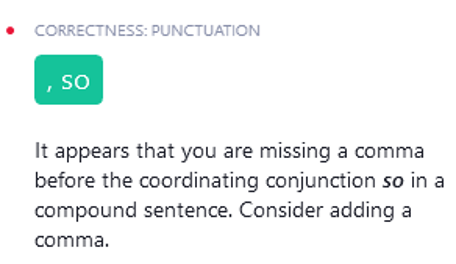
Both Microsoft’s grammar checker and Grammarly software flagged my lack of a comma after an initial “so” as a problem. However, both of those automated checkers make plenty of mistakes, as I’ve discussed elsewhere, including in “How I use Grammarly to improve my writing.” Moreover, note that the wording of Grammarly’s comment leaves open the possibility that you might not need a comma.

Grammarly so

Pick your style

You can make a case for using or skipping commas in this situation. I’m starting to skip them because my clients are fond of multi-clausal sentences. I figure that fewer commas will make their sentences easier to absorb.

3 times to use passive verbs in your writing

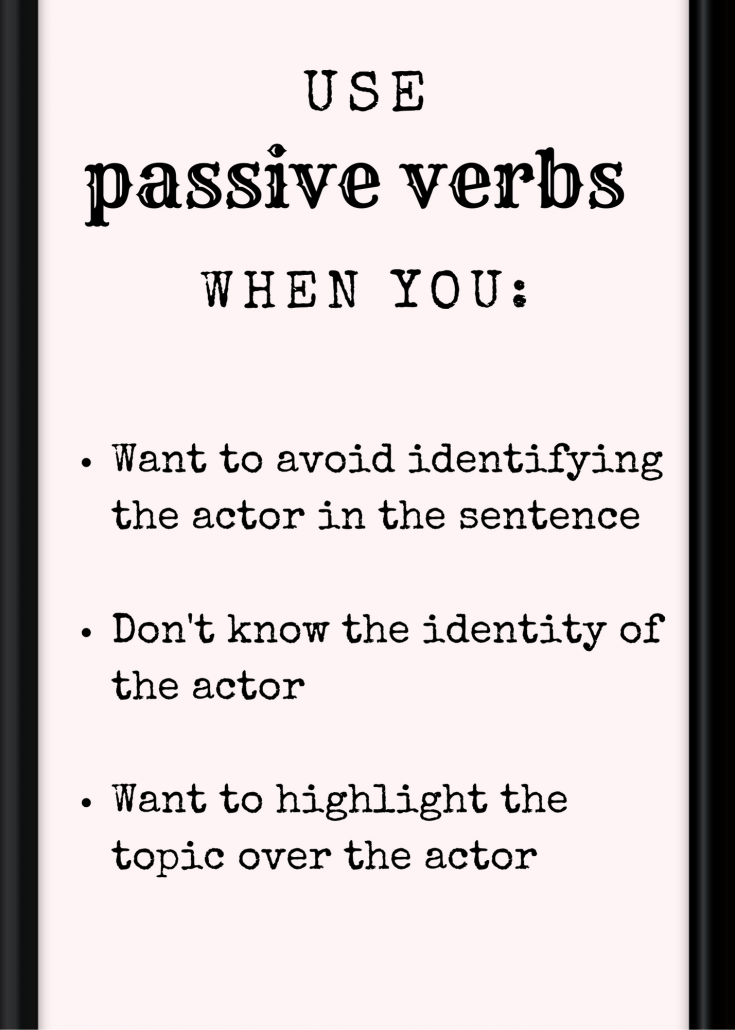
I usually slash passive verbs in articles that I edit. (Don’t know what a passive verb is? Read this.) But sometimes I leave them in place. When? When the sentence should emphasize the person or thing that the verb is acting on. Or, when you don’t want to identify the person or thing that is taking an action.

Use the passive voice in the following three instances.

1. When you want to avoid identifying the actor

Imagine that you’re communicating with a client who mistakenly deposited money into the wrong account. Do you want to emphasize the client’s mistake, as if to say, “Hey, stupid, you put money in the wrong account”? No, it’s better to say, “Money was deposited in the wrong account,” and then describe how to fix the problem.

A classic example of failing to identify the actor is the sentence: “Mistakes were made.” Sentences like that make me want to shake the author. I want to yell, “Tell me who made the mistake!” I sometimes see such sentences in descriptions of investment underperformance. I don’t agree with that approach. I think it’s better to identify the reason for underperformance and say what you’re going to do about it. I discussed that in “Four lessons from Wasatch Funds on reporting underperformance.”

2. When you don’t know the identity of the actor

Sometimes the problem with active verbs isn’t that you don’t want to identify the actor. It’s that you don’t know what the heck caused the action. For example, “The price of PQR stock was depressed.”

Perhaps that’s a bad example because you can usually find a pundit to opine on the reason for a stock price movement. However, perhaps you want to be honest about your not really knowing the reason for the stock price decline.

3. When you want to highlight the topic over the actor

Sometimes the actor is less important than the subject that it’s acting on. For example: “The conditions are forming for a dramatic decline in stock prices.” In this case, the factors driving the decline are less important than the imminent decline.

Stay active most of the time

Despite the fact that passive verbs are sometimes appropriate, please go easy on using them. Active verbs are usually better.


Go from short to long!

Rearranging elements of a sentence “from short to long, from simple to compound, increases the ability of the reader to understand them,” says Bruce Ross-Larson in Edit Yourself: A Manual for everyone who works with words, one of my favorite editing books.

Ross-Larson has three related rules.

  • First, count the syllables. This will let you identify shorter words to put first.
  • Then, “if the number of syllables is the same, count the letters.” That can be a tie-breaker.
  • Finally, “Put the compound elements last.” As an example, he suggests that “life, liberty, and the pursuit of happiness” reads better than “liberty, the pursuit of happiness, and life.” I guess that’s why the Declaration of Independence uses the suggested order.

Of course, these three rules don’t always apply. As Ross-Larson says, don’t follow the rules if that’ll:

  • Put elements out of chronological or sequential order
  • Create unintended modifiers
  • Upset a familiar or explicit order, such as “the birds and the bees” or going in order from more conservative to less conservative asset classes

Small changes like this can make your writing easier to read. That means you’re likely to convey your message more effectively.


Disclosure: If you click on an Amazon link in this post and then buy something, I will receive a small commission. I provide links to books only when I believe they have value for my readers.

Can you use numerals at the start of a sentence?

One of the first writing rules I learned was that I can’t use numerals to start a sentence. But in recent years, my certainty about that rule has been shaken.

Headlines can start with numerals

First, I learned that it’s OK to start an article headline with a numeral, at least in Associated Press (AP) style, because AP style only uses numerals—not spelled out numbers—in headlines. I operate mostly in a world of AP style. A headline isn’t a sentence, but it’s the next closest thing.AP StyleBook
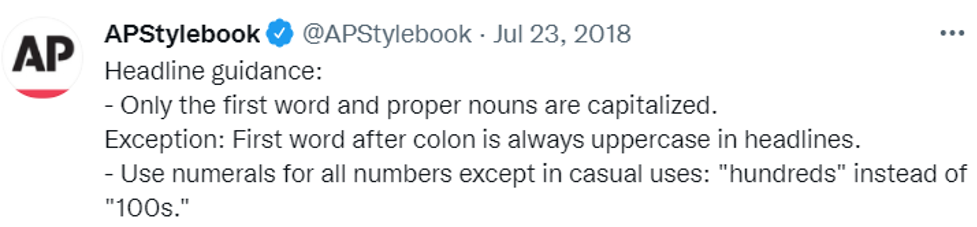
Years and 401(k) as exceptions in AP style

More recently, I stumbled across this rule in the online AP Stylebook (subscription required): “Years are an exception to the general rule in numerals that a figure is not used to start a sentence: 2013 was a very good year.” Wow, that’s a big change for me!

Also, it turns out that I can start a sentence with the term “401(k)” and be in compliance with AP style. Here’s the relevant rule:
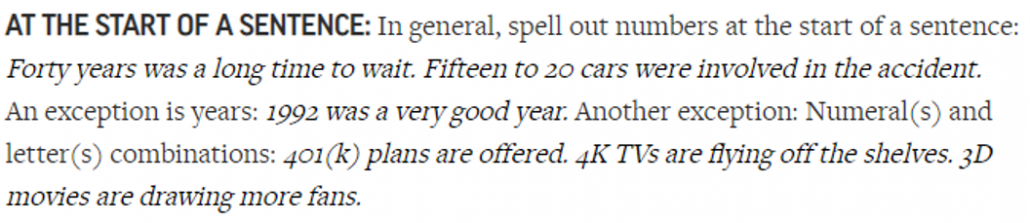
At the start of a sentence

CMOS takes a different approach

I can explain my ignorance partly in terms of my learning style rules in college and graduate school under teachers who used the Chicago Manual of Style (CMOS). Plus, I used CMOS for my Ph.D. dissertation.

Here’s what CMOS says about this topic:
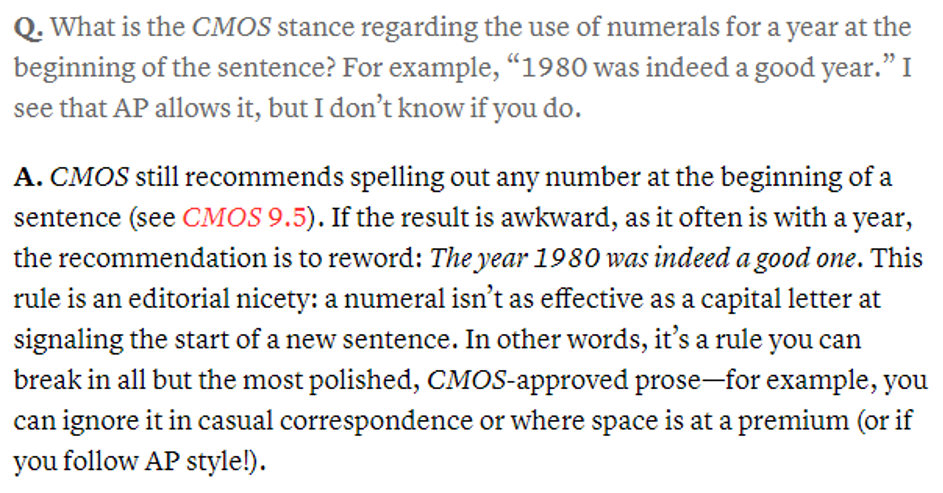
CMOS numerals

Readers are confused

I know I wasn’t alone in my confusion. Look at the responses I received when I polled my LinkedIn connections about this topic.
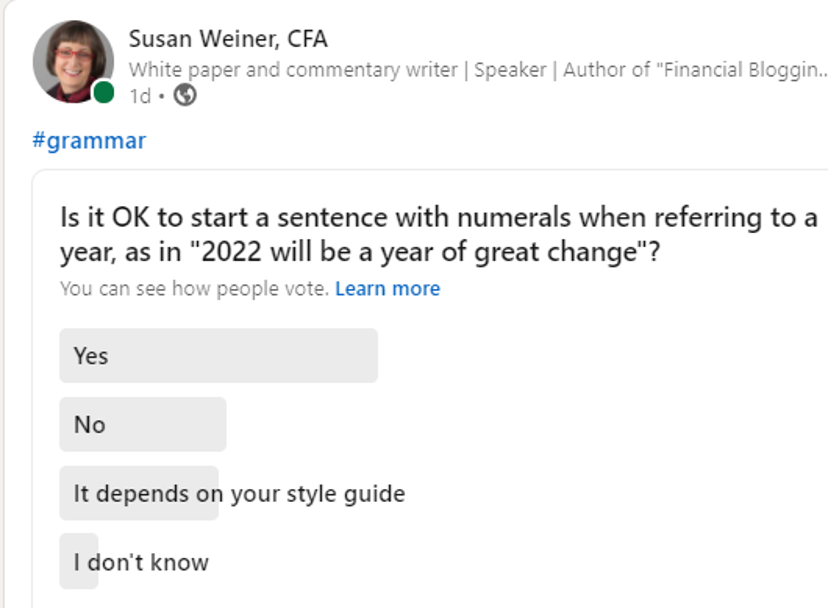
start sentence with numerals

Am I going to change my writing style to accommodate this new information? Maybe sometimes. In general, however, I’ll try to write in a way that doesn’t require putting 2022 or 401(k) at the start of a sentence.

Sure, it’s right under AP style to start a sentence that way. However, there will be CMOS followers and others who look at that sentence and think, “Susan, that’s wrong.” I blogged about this problem in “Being right about grammar isn’t always good enough.”


Disclosure: If you click on the Amazon link in this post and then buy something, I will receive a small commission. I link only to books in which I find some value for my blog’s readers.


Note: I edited this post on Sept. 30, 2022.