Can you use numerals at the start of a sentence?

One of the first writing rules I learned was that I can’t use numerals to start a sentence. But in recent years, my certainty about that rule has been shaken.

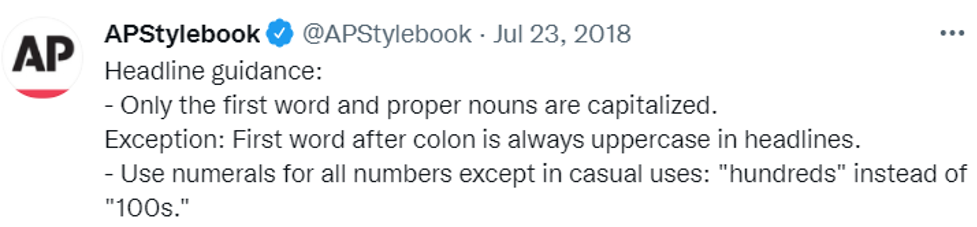
Headlines can start with numerals

First, I learned that it’s OK to start an article headline with a numeral, at least in Associated Press (AP) style, because AP style only uses numerals—not spelled out numbers—in headlines. I operate mostly in a world of AP style. A headline isn’t a sentence, but it’s the next closest thing.AP StyleBook

Years and 401(k) as exceptions in AP style

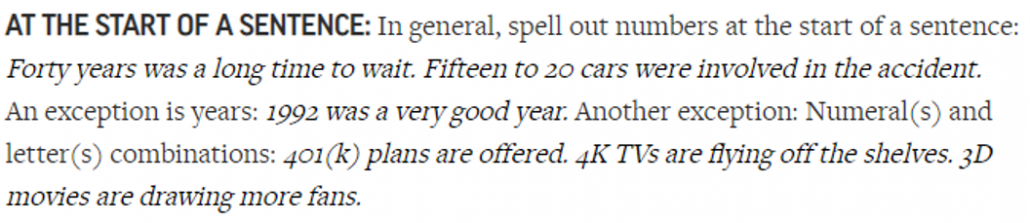
More recently, I stumbled across this rule in the online AP Stylebook (subscription required): “Years are an exception to the general rule in numerals that a figure is not used to start a sentence: 2013 was a very good year.” Wow, that’s a big change for me!

Also, it turns out that I can start a sentence with the term “401(k)” and be in compliance with AP style. Here’s the relevant rule:

At the start of a sentence

CMOS takes a different approach

I can explain my ignorance partly in terms of my learning style rules in college and graduate school under teachers who used the Chicago Manual of Style (CMOS). Plus, I used CMOS for my Ph.D. dissertation.

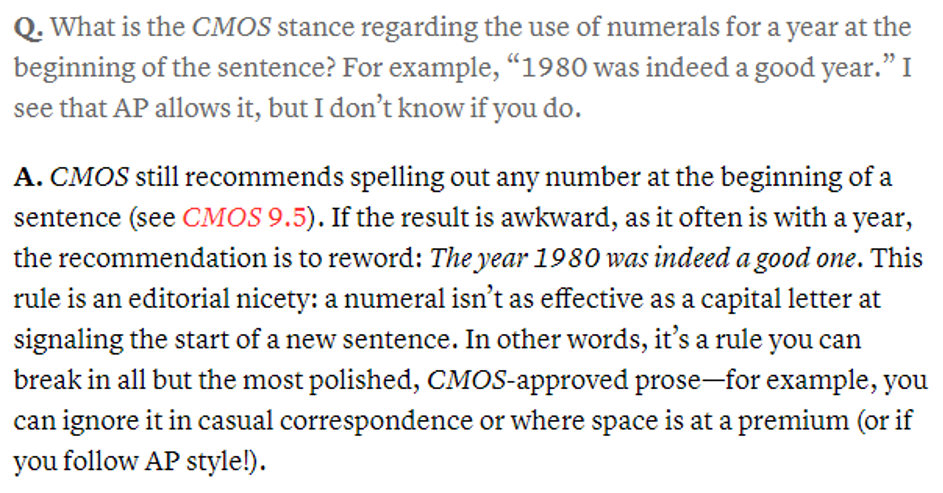
Here’s what CMOS says about this topic:

CMOS numerals

Readers are confused

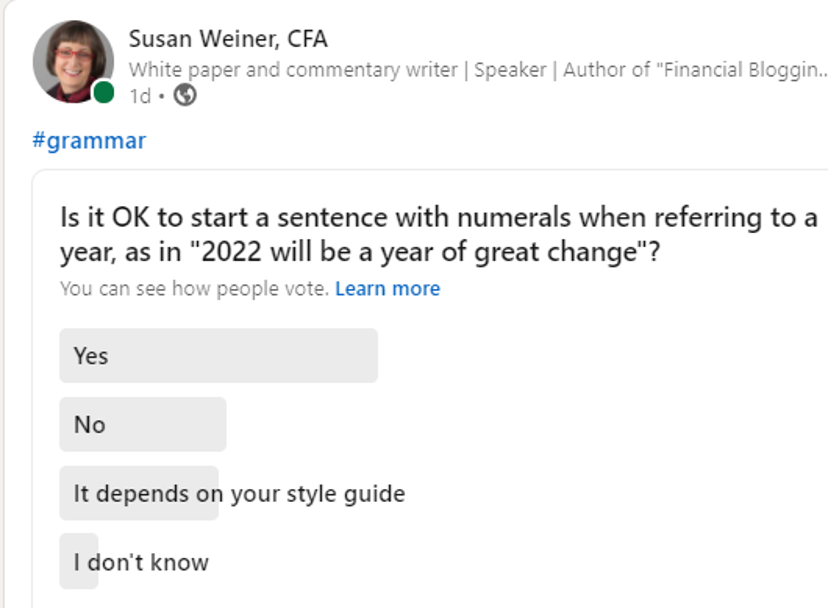
I know I wasn’t alone in my confusion. Look at the responses I received when I polled my LinkedIn connections about this topic.

start sentence with numerals

Am I going to change my writing style to accommodate this new information? Maybe sometimes. In general, however, I’ll try to write in a way that doesn’t require putting 2022 or 401(k) at the start of a sentence.

Sure, it’s right under AP style to start a sentence that way. However, there will be CMOS followers and others who look at that sentence and think, “Susan, that’s wrong.” I blogged about this problem in “Being right about grammar isn’t always good enough.”


Disclosure: If you click on the Amazon link in this post and then buy something, I will receive a small commission. I link only to books in which I find some value for my blog’s readers.


Note: I edited this post on Sept. 30, 2022.

Should you hyphenate “fixed income”?

It depends.

There are two schools of thoughts about whether to hyphenate compound adjectives, which is what “fixed income” becomes when you use it as an adjective. It’s the reader-friendly approach vs. common usage.

Reader-friendly

Let’s talk about “fixed income investing.” When you combine an adjective and noun and then use them to describe a second noun, you’re creating a compound adjective.

You’re also making it more difficult for your readers to interpret your text. They’re used to thinking of “income” as a noun, so they may struggle for a moment before they realize that “fixed income” serves as an adjective in “fixed income investing.” Following this line of thought, it’s kinder to your reader to write “fixed-income investing.”

Common usage

Opponents of writing “fixed-income investing” say “fixed income” is so commonly used as an adjective that a hyphen is unnecessary.

Your decision

Grammar Girl says that you should always consider whether a hyphen changes your meaning. As she pointed out in a post that has been removed from her website:

  • A hot-water bottle is a bottle for holding hot water.
  • A hot water bottle is a water bottle that is hot.


The Wall Street Journal uses a hyphen when fixed-income is an adjective.

What’s your decision? Is it fixed-income investing or fixed income investing?

Whichever approach you adopt, be consistent in your usage. That will help your readers know what to expect.


NOTE: Updated on Feb. 17, 2026 for a broken link.

Image courtesy of iosphere at FreeDigitalPhotos.net.

Do your grammar, punctuation, and usage affect your credibility?

Does the quality of your writing matter? It looks like it does. When I asked “Does a writer’s grammar, punctuation, or usage errors damage that writer’s credibility in your eyes?”, an amazing 100% of respondents said “yes” in response to the survey on my blog and in my newsletter.

Specifically, they gave the following answers to my multiple-choice question.

0%   No, I don’t notice errors
0%   No, I don’t care
26% Yes, but I forgive small mistakes, especially in social media posts
74% Yes, they damage the writer’s credibility

I imagine that my readers are more critical than the general population. Still, these numbers should make all of us, including me, pay closer attention to how we write.

Respondent comments on bad writing

As one respondent commented, “Having your reading disrupted by a misspelled word or badly written sentence is like having air suddenly let out of a balloon. It makes me question the writer as well as the content.” Another reader said, “it reflects poorly on the writer and shows lack of attention to detail.” On a similar note, one person wrote, “There’s always that nagging feeling: if they didn’t care enough to proofread this, where else are they cutting corners? I try to be charitable because I too make mistakes, but it really bugs me.”

In their comments, readers showed some tolerance for mistakes. Here’s one example, “To me, it shows the writer is not detailed enough to review their input before hitting ‘go’ – drives me crazy. That being said, I hit the wrong key often when texting and sometimes miss it before sending, so I have a small tolerance for those sort of errors.”

Believe it or not, despite concerns about writing mistakes, I fall into the 26% of people who tolerate small mistakes, especially in social media.

The worst mistakes?

The second question in my survey asked, “What is the worst mistake that writers make? Why is this mistake bad?”

Popular answers included spelling mistakes, mistakenly using “it’s” as the possessive form of “it,” and failing to proofread.

Here are more answers to my question about the worst mistakes:

“It’s a toss-up between thinking they are texting and using texting acronyms and overloading their writing with technical jargon.”

“Writing with very little thought and planning… poor sequencing of ideas, incomplete sentences, stream of consciousness, no clear call to action. When that’s the output, why bother?”

“Since I read almost no fiction–in my job, I don’t have to because what I see and hear no writer could make up–I confine my comment to non-fiction. Embedding numbers inside paragraphs abuses most readers because it asks them to ‘see’ relationships between and among numbers that can be shown much more easily with charts and graphs.”

“Using too many words. I want to get the point, learn the lesson without reading useless words.”

Dave Spaulding on writing mistakes

I’m not the only person raising these questions in the world of investment management. You can read Dave Spaulding’s “Should GIPS verifiers correct grammar? Spelling?

When Dave sees mistakes, he recommends changes. In his blog post, he says, “On occasion, I’ve discussed this with our clients, and in every case the client has been very clear that they welcome my comments. Most want their materials to be as correct in all respects as possible.” That’s good news.


March 13, 2017 update: The original version of this post linked to my original survey. I updated the post to focus on the survey results, which I’d published in my newsletter.

Jan. 22, 2025: I made minor updates.
Nov. newsletter: Fewer or less?

Happy Thanksgiving to my U.S. readers! I hope you enjoy a nice holiday later this month.

Fewer versus less

Which should you use—“fewer” or “less”? The Merriam-Webster Dictionary explains the rule clearly:

Generally, fewer is used when a number of things can be counted (“fewer problems”) and less is used when an amount is measured (“less trouble” or “less time”).

Of course, there are exceptions that complicate things. For more insights into the topic of fewer versus less, see

Medicare open enrollment

With Medicare open enrollment in process, it’s a good time to remind your clients about SHIP, the free, unbiased Medicare insurance counseling service.

If you or your clients would like to understand Medicare better, check out free newsletters from sources like 65 Incorporated and Healthassist.


Avoid the taint of AI

Find some helpful tips on how to avoid publishing content that reads like it has been written using generative artificial intelligence (AI). Read “How to Edit the AI-isms Out of Your Content (No Detectors Needed)” on the Contently blog.

I especially like the tips to “Insert local or unique details” and “Increase use of expert quotes or original input.”

The article cites one sign of AI intervention that doesn’t apply to investment and wealth management content. It warns against hedging language, “terms or phrases that weaken the assertiveness of a statement and make it less absolute.” If you’ve worked in financial services for a while, you know that your compliance professionals love hedging language. It does protect you and your readers.


Winslow Homer at the MFA

Check out the beautiful exhibit of Winslow Homer watercolors at the Boston Museum of Fine Arts. It runs until Jan. 19, 2026.

Winslow Homer in Watercolor exhibit at Boston Museum of Fine Arts

Winslow Homer exhibit at the Boston Museum of Fine Arts

Financial Blogging, my five-star-rated book

Here’s what advisors say about my book.

  • A great read for advisors who want to blog better—or learn how to start!
    Michael Kitces, Nerd’s Eye View
  • Susan’s words have helped me hone my message and become clearer in my explanations. Through my dedication to blogging, my business has grown as a result. I owe much of my success in business to Susan’s teaching and guidance.
    Dave Grant, Finance for Teachers
  • I wish I had read Susan’s Financial Blogging before I produced 300 weekly posts. There was a lot of practical advice in a slim guide to producing effective blogs. The blog preparation work sheets should be of particular value to an author who wishes to get smart people to do smart things with their money. My posts will be better for having read the book.
    A. Michael Lipper, Mike Lipper’s blog

What my clients say about me

“Fast, effective, insightful. I can think of no better resource for superior financial writing.”

“Susan has an exceptional ability to tailor investment communications to the sophistication level of any audience. She has an uncanny ability to make very complex investment and/or economic topics accessible and understandable to anyone.”

“Susan’s particularly good at working through highly technical material very quickly. That’s very important in this business. A lot of people are good writers, but they have an extensive learning curve for something they’re unfamiliar with. Susan was able to jump very quickly into technical material.”

Read more testimonials!


Improve your investment commentary

Attract more clients, prospects, and referral sources by improving your investment commentary with 44 pages of the best tips from the InvestmentWriting.com blog.

Tips include how to organize your thoughts, edit for the “big picture,” edit line by line, and get more mileage out of your commentary.

Available in PDF format for only $9.99. Email me to buy it now!


Boost your blogging now!

Financial Blogging: How to Write Powerful Posts That Attract Clients is available for purchase as a PDF ($39) or a paperback ($49, affiliate link).


MISTAKE MONDAY for May 26: Can YOU spot what’s wrong?

Can you spot what’s wrong in the image below? Please post your answer as a comment.

apostrophe


Want a clue to this week’s big mistake? Read my post on “Bloggers’ top two punctuation mistakes.” It doesn’t discuss this exact mistake, but it’ll point you in the right direction.

I post these challenges to raise awareness of the importance of proofreading. I make mistakes, too. Mistake Monday keeps me vigilant. After all, I don’t want to make any more mistakes worthy of posting here.

MISTAKE MONDAY for April 28: Can YOU spot what’s wrong?

Can you spot what’s wrong in the image below? Please post your answer as a comment.

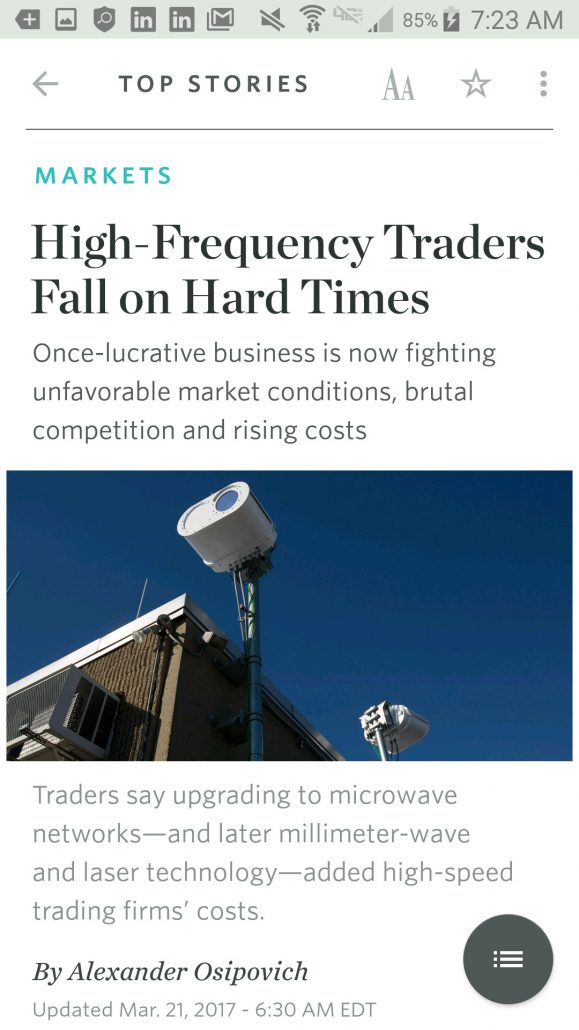
added added to


Once again, here’s an error in a major newspaper. I suspect that text, such as headlines and captions, that isn’t written by the reporter may be particularly prone to becoming fodder for Mistake Monday. Do YOU have a theory explaining these errors?

I post these challenges to raise awareness of the importance of proofreading. I still struggle with proofreading my own work.

MISTAKE MONDAY for October 28: Can YOU spot what’s wrong?

Can you spot what’s wrong in the image below? Please post your answer as a comment. I hate spotting mistakes like this.

Mistake Monday who's whose BillW
I post these challenges to raise awareness of the importance of proofreading.

MISTAKE MONDAY for September 30: Can YOU spot what’s wrong?

Can you spot what’s wrong in the image below? Please post your answer as a comment. This is another common error.

Mistake Monday weeks week's


I post these challenges to raise awareness of the importance of proofreading.

MISTAKE MONDAY for August 26: Can YOU spot what’s wrong?

Can you spot what’s wrong in the image below? Please post your answer as a comment. I wonder if the author dictated their text.

Mistake Monday you're your 2
I post these challenges to raise awareness of the importance of proofreading.

MISTAKE MONDAY for July 29: Can YOU spot what’s wrong?

Can you spot what’s wrong in the image below? Please post your answer as a comment. I’m embarrassed to say that this was my own typo. I started Mistake Monday to encourage myself to proofread more carefully.

Mistake Monday that ____
I post these challenges to raise awareness of the importance of proofreading.