Blog post template: Write about a talk

Do you get tired of generating original material for your blog? Do you attend talks on topics that would interest your blog’s audience? If so, you can benefit from this template for blogging (or writing an article) about a talk. This blog post template will help you to spend less time thinking and writing. Plus, you’ll get better results from what you write.

This blog post template draws on my many years of blogging about presentations that I attended at the Boston Security Analysts Society. Plus, I also covered conference presentations as a staff reporter for Dalbar’s Mutual Fund Market News (now Money Management Executive) and as a freelance writer for Advisor Perspectives. If you’d like to learn more about writing blog posts, check out my financial blogging class.

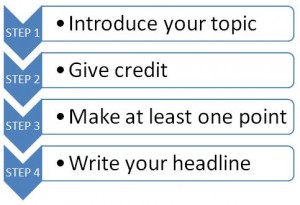
Here is the process you can follow to apply my blog post template:blog post template for talks

  1. Introduce your topic
  2. Give credit
  3. Make at least one point
  4. Write your headline

Step 1. Introduce your topic

Don’t make the mistake that too many amateurs do. Don’t kick off your article by saying “I went to a talk and it was great.”

Instead, start by sharing the speaker’s topic or main point. For example, I led with “‘U.S. economic growth is recovering robustly, receiving the usual cyclical boost from housing and inventories,’ said Dean Maki” in “Recovery will be stronger than consensus, says Barclays Capital chief U.S. economist,” a 2009 blog post. This quickly told the reader what they’d learn in the piece.

Doesn’t that beat the heck out of an introduction that lacks substance? For example, I can imagine an inexperienced writer starting with something like the following: “I went to one of the Boston Security Analysts Society’s excellent lunch presentations for Boston area investment professionals where Dean Maki, managing director and chief U.S. economist of Barclays Capital spoke and I got some great insights into the U.S. economy.” Yes, I’m exaggerating how badly most people write. However, I bet that you’ve read plenty of blog posts and newsletter articles that started similarly. Still, I am grateful that those authors take the time to credit the source of the observations that follow their introductions. That’s far better than presenting someone else’s ideas as your own.

Step 2. Give credit

If you pick up some great ideas at a talk, it’s good to give credit to your source. Just don’t write it in the way that I’ve parodied in the preceding paragraph.

Name the speaker, the title of his or her presentation, the sponsoring organization, and the date, if applicable. This information helps your readers to assess the credibility of the information in your blog post. The date will cue in the reader if information cited in the presentation is no longer current.

Here’s how I gave credit in the first paragraph of the Maki post:

“U.S. economic growth is recovering robustly, receiving the usual cyclical boost from housing and inventories,” said Dean Maki, managing director and chief U.S. economist of Barclays Capital in his “U.S. Economic Outlook” presentation to the Boston Security Analysts Society (BSAS) on December 8.

In the Maki post, I covered steps 1 and 2 in my first paragraph. Then, I moved to Step 3.

Step 3. Make at least one point

When you report on a talk, you don’t need to cover everything the speaker says. Especially in a short blog post, it’s fine to focus on one point.

In the Maki post, I focused on the economy’s strength, the theme introduced in my first paragraph.

Here’s the structure for the rest of the post, in terms of points made:

  • Paragraph 2: Maki sees a strong recovery, in contrast with the consensus, because he doesn’t see tight credit as a problem.
  • Paragraph 3: He thinks strong growth will be driven by these factors.
  • Paragraph 4: Here are his specific predictions for the economy.
  • Paragraph 5: Maki sees two things that could derail his predictions.

Here’s the flow of the piece, in terms of the actions I took:

  1. State the speaker’s main opinion.
  2. Provide supporting evidence.
  3. Go into more detail about what the information covered above means.
  4. Provide information about what could go wrong.

Here’s a generic version of my blog post template for you to follow.

  1. State the speaker’s main opinion.
  2. Make your first point. For example, you could describe the main piece of supporting evidence offered by the speaker. Or, you could describe the first of the speaker’s three main suggestions. Or, tell a story that illuminates the speaker’s main opinion.
  3. Make your second point. For example, you could explain the second piece of supporting evidence offered by the speaker. Or you could explain why you disagree with the speaker’s main point.
  4. Make your third point. For example, you could introduce a related theme discussed by the speaker.
  5. Offer a conclusion or call to action. For example, if you’re an investment or wealth manager reporting on economic predictions, you might say how the predictions will influence how you manage money for your clients—or how the predictions should influence your readers’ behavior.

Step 4. Write your headline

It’s often easier to write your headline after you’ve completed writing your entire blog post or article. Writing may help you to identify your main point so you can feature it in your title. For the Maki post, I chose “Recovery will be stronger than consensus, says Barclays Capital chief U.S. economist.”

In addition to highlighting the main point, I included Maki’s corporate affiliation. I chose that over his name because I figured that Barclays Capital had better name recognition.

Apply this blog post template to a longer article

When you write a longer article, you may feel tempted to cover more of the speaker’s twists and tangents. You may also try to present the information in the order and structure used by the speaker. Sticking closely to the speaker’s approach may hurt your article or blog post.

Some speakers wander all over the place. That’s fine when you’re listening to an insightful, entertaining speaker. However, that structure doesn’t translate well into writing. I urge you to pick one theme and stick with it.

I ran into the problem of the wandering speaker when I wrote “Dan Fuss: The 50-Year Opportunity in Bonds” for Advisor Perspectives in Dec. 2008. Fuss held his audience rapt, but he rambled. He’s a leading thinker in the area of fixed income, so any speech by him is an opportunity to gain valuable insights. Still, his talk didn’t lend itself easily to becoming an article. However, along the way he made one point that riveted me: Opportunities in the bond market are as attractive now as they have been in at least 50 years.

The 50-year opportunity in bonds became the focus of my piece, which hit the top 10 list on Advisor Perspectives. I focused the article under two headings. First, “Treasuries overvalued, and investment-grade and high-yield attractive”; and second,”When will it end?”

Believe me, the talk Fuss gave was not as focused as my article. It’s fine for a talk by a leading thinker in the field to ramble. It’s not okay for a written piece. To fix the problem, I created a structure that didn’t exist in the original talk.

To identify the main themes for my article, I used mind mapping, which I teach in my book and my financial blogging class. Then, I used the mind map to organize my thoughts before writing the article.

Sometimes the most important decision you make in writing up a speech is what to omit. I ignored lots of my notes because they didn’t support my theme of the 50-year opportunity in bonds.

Try this blog post template

If you use my blog post template to write about a talk that you attend, please post a link in the Comments section of this blog. If you’d like more guidance from me on how to write this kind of piece, you can sign up for one-on-one coaching or my financial blogging class.

Do you want to succeed as a financial blogger?

My financial writing crusade

“Are you on a crusade?” A reader asked me that question with a smile after he read the Barron’s article that quoted me on the need for financial writers to lower the grade level of their writing.Chronique d'Ernoul et de Bernard le Trésorier - caption: 'Crusaders besieging Damascus'

If you’re a regular reader of this blog, you’ll probably say the answer is “Yes, I am on a financial writing crusade.” After all, I often urge people to improve their financial writing. Plus, I put the term in the title of this post, picking up on the wording of my reader’s question.

However, I prefer to think of myself as an advocate for good writing. The word “crusade” has overtones of intolerance and single-mindedness. I don’t want to demean people who are doing their best to communicate. Indeed, sometimes poor writing can be good enough for the situation. Think, for example, about a condolence card. The sincere expression of sympathy is more important than the worst misspellings and awkward wording.

Still, good financial writing beats bad financial writing. It’s important because good financial writing helps people to understand the world of earning, spending, saving, and investing. It might even make the difference between an individual sleeping peacefully instead of tossing and turning at night, due to worries over an investment. It might prevent litigation when risks are clearly disclosed by a disclosure document. On a less dramatic note, it might help institutional investors to choose the strategy that’s right for their unique circumstances.

Here’s what I believe about good financial writing.

Everyone can learn to write better

Good writers are made, not born. You’ll benefit from having other people read and edit your work. Classes, reading and analyzing other people’s work, and using software tools also help.

I think of myself as a good writer, but I still have room for improvement. I continue to read and get feedback from others to enhance my writing.

I’ve come a long way. I mention this to make you realize that you also can improve. As I said in an earlier post, “I wince when I read selections from my Ph.D. thesis, Bureaucracy and Politics in the 1930s: The Career of Goto Fumio.” It’s full of the kind of writing that I warn people against today. My path to improvement involved taking many writing classes, participating in writing groups, and being edited by savvy editors.

I’ve been thrilled to see some of the hard-working students in my financial blogging class make big improvements in their writing. Even small improvements can help. For example, if your sentences average 32 words in length, cutting the average length to 22 words will boost your readability.

You’ll benefit from becoming aware of your writing grade level

To improve your writing, you need to learn your weaknesses. One of the biggest weaknesses of much financial writing is that it’s too long-winded. The authors use too many multisyllabic words in long, convoluted sentences that pile one upon another in impenetrable paragraphs.

To get an idea of how you rate in terms of long-windedness, look at your grade level, which I discussed in “Donald Trump, grade level, and your financial writing” and “Free help for wordy writers!” Grade level calculations reflect the average length of your words and sentences.

However, don’t use grade level as the only measure of your work’s quality. Sometimes longer sentences are clearer than short sentences.

Different grade levels and vocabulary work for different audiences

The grade level and vocabulary that you can get away with depends on your audience.

Imagine that you’re a fixed-income strategist writing to your team about a change in your strategy. Using technical terms such as “duration” and “convexity” is perfect for your audience of investment professionals. These concisely convey your meaning in an exchange between professionals. You can also get away with writing long because your readers, as your employees, are highly motivated to read what you write. If they don’t grasp it, they can’t do their jobs.

Now, imagine that you need to communicate the strategy to an audience of unsophisticated individual investors. If you don’t delete the technical terms—or explain them in plain language—you’ll lose your readers. They won’t have a clue what you’re talking about. Plus, they may not care about the fine points of your strategy. Unlike your professional colleagues, they’re not motivated to stick with you.

In general, I believe institutional investors and other financial professionals crave more details than the individuals in your audience. Still, they’ll appreciate it when you streamline your writing, even when they  approve of your using technical terms. Better writing benefits everybody.

Learning how to organize your thoughts before you write will help

Many professionals struggle to write. It takes them a long time to draft and edit their writing.

I’d like you to suffer less through the writing process. Organizing your thoughts before you write will help. One of the inspirations for my book, Financial Blogging: How to Write Powerful Posts That Attract Clients, was my desire to describe a step-by-step process for writing that includes organizing your thoughts before you write.

When you know what you want to say and you organize your thoughts before you write, you’ll write faster and more clearly. When you use a repeatable process tailored to your needs, your stress declines even more. This is part of what I teach in my financial blogging class.

Don’t let legal and compliance feedback ruin your writing

I know some great people who work in the legal and compliance areas for registered investment advisors, registered representatives, and other financial organizations. However, as one of my old bosses told me, “Legal never gets in trouble for saying ‘No.’ ”

Learn enough about legal and compliance requirements so you can push back when necessary. Sometimes your legal or compliance experts make changes that are a matter of their style preferences—not legal or regulatory requirements. In addition, the jargon used by some legal and compliance experts can inspire the confusion and litigation that they’re trying to avoid, as I discussed in “Ammo for your plain-language battle with compliance.”

People who write badly aren’t bad or stupid people

There’s no need to shame people who write badly. They aren’t bad people. Nor are they stupid. They simply haven’t been educated yet. Or perhaps they don’t have an aptitude for writing. We all have different strengths.

If you follow me on social media, you have seen my Mistake Monday posts, in which I invite readers to test their proofreading skills by finding typos and other errors in writing samples. I don’t call those people stupid. I can’t. That’s because I’ve posted many of my own errors on Mistake Monday.

It’s hard for us to catch our own errors. If you want to catch more of your errors, here’s one of my best proofreading tips.

Let’s show compassion to the people who don’t write as well as we do.

What do you believe about good writing?

I’d like to hear from you. Tell me what you believe about good financial writing.

Image courtesy of The British Library/flickr

When do I need quotation marks?

When should you use quotation marks? You probably know that you should use them around quotations or around the titles of some artistic works. (Books are an exception to the artistic works rule, except in AP style.) But other cases are open to debate.

I find that non-professional writers sometimes use quotation marks for emphasis, instead of their intended purposes. I don’t like that. Nor do most professional writers.

Garner’s Modern American Usage lists three times, in addition to when you’re identifying quotations or titles of artistic works, when you should use quotation marks:

  • when you’re referring to a word as a word, <the word “that”>, unless you’re using italics for that purpose
  • when you mean so-called-but-not-really <if he’s a “champion,” he certainly doesn’t act like one>
  • when you’re creating a new word for something—and then only on its first appearance <I’d call him a “mirb,” by which I mean…>

Some sources disagree with Garner and me on avoiding the use of quotation marks for emphasis, but urge discretion. Here’s what Amy Einsohn says in The Copyeditor’s Handbook: A Guide for Book Publishing and Corporate Communications:

Quotation marks may be used for emphasis or irony, but copyeditors should curb authors who overuse this device.

I’m okay with using quotation marks for irony. I believe that’s what Garner aims at in his so-called-but-not-really case. But I prefer to avoid using them for emphasis. In fact, I almost deleted Einsohn’s quote from this post because I dislike them so much.

You can make your own rules on this issue, but I suggest that create a style sheet to help you apply your rules consistently.

What do YOU think about quotation marks?

If you have strong feelings about the usage of quotation marks, please share. If you suggest a different set of rules, it’d be great if you could cite a source for your recommendation.

Disclosure: If you click on the Amazon link in this post and then buy something, I will receive a small commission. I only link to books in which I find some value for my blog’s readers.


Financial content: Ask questions of your readers

Coming up with financial content can be challenging. Where do you get the information to put in whatever you write? Questions are a great source of information for investment and wealth managers’ tweets, blog posts, articles, and even white papers. I recommend that you keep a paper or electronic notepad handy to record questions asked by your clients.financial writing content

However, sometimes you need a fresh source of inspiration, opinions, and information. It’s time to turn the tables. Ask questions to generate financial content.

1. Ask questions that people can answer with one word

A webinar presenter—I think it was social media strategist Amy Porterfield—suggested boosting Facebook engagement by posing questions that ask for a one-word answer. Because you request little from your audience, it’s easy for them to respond.

Inspired by this idea, I asked on Facebook and in LinkedIn groups for my readers to share one word that defined ideal investment commentary. The volume of replies astonished me. At one point my question was the “Manager’s Choice” on the CFA Institute’s LinkedIn group. It was nice visibility for me. I believe it happened because group members enjoyed the opportunity to express themselves on a topic about which they felt passionately. The group members’ answers broadened and deepened my understanding of my topic.

2. Run an online survey

My readers’ enthusiastic reply to my one-word question about investment commentary inspired me to create an electronic survey about the characteristics of good investment commentary.

Readers’ answers eventually led to “Ideal quarterly investment letters: Meaningful, specific, and short,” a key piece of content on my blog.

I used some open-ended questions in addition to easy-to-answer multiple-choice questions. When you include open-ended questions, you allow your readers to develop original content for you. A meaty blog post can result. However, be aware that analyzing the non-quantitative survey results can be time-consuming. While a program like SurveyMonkey can compile the quantitative answers, it can’t sort through text answers. You’ll need to evaluate the meaning of the answers and identify the best material yourself.

In the compliance-sensitive world of financial services, I find that people like the anonymity of online surveys. They feel free to express themselves in ways they’d shun if they needed approval from a compliance officer. This can spark colorful quotes.

When you write about what your readers say, you give them a voice. This helps you to build a sense of community with them. Reader-generated content also adds a sense of authenticity to what you write. This is especially true when you include direct quotes.

3. Run a multiple-choice poll

“I voted ‘yes’ on your poll.” Back in the days when I ran a poll in my monthly newsletter, my newsletter readers often mentioned my polls when I met them one-on-one. If you publish the poll results only in your e-newsletter, as I used to do, you give readers an incentive to subscribe. That’s always a plus.

Like the one-word-answer technique, multiple-choice polls don’t require much effort for people to answer, which boosts participation.

I often enable readers to add their own responses to the polls, rather than choosing from those I’ve listed. I’ve received some good insights from allowing them this freedom.

By the way, consider testing your poll on a member of your target audience before you release it. Your instructions or questions may not be as clear as you think. I think I’m a clear writer, but my outside readers have helped me to refine my questions for better results.

4. Start discussions on social media

Posing a question on LinkedIn or other social media is a great way to collect content. I especially like doing this on LinkedIn because all of the answers are collected in one place. Also, one person’s response often sparks another.

When a social media question inspires a lively conversation, that says that the topic is worthy of a blog post. It’s likely to be shared widely.

Career strategies for wealth managers without a book of business” is essentially a compilation of answers that LinkedIn members posted in response to a question. I quoted only LinkedIn Group members who gave me their permission since I posted my question on a members-only group. If you post on a public group, then technically you don’t need to ask permission. However, I think it’s the right thing to do, unless you explicitly warn people in your original post that you are looking for quotes.

5. Ask “What do you want to read?” at every opportunity

You can ask clients, prospects, referral sources, and social media connections “What do you want to read?” Also, What’s your opinion on that?” The people whom you ask will be flattered you asked for their opinion.

More ideas for generating financial content

By the way, for another perspective on using surveys and questions, read “3 Ways to Create Highly Valuable Blog Content” on the Social Media Examiner blog.

You can learn even more ideas for generating financial writing topics and content when you sign up for my class, “How to Write Blog Posts People Will Read: A 5-Week Writing Class for Financial Advisors.” The next session starts in February 2016.

What do you want to read?

Of course, I’d like to learn more about YOUR interests. Please leave a comment suggesting topics for future blog posts.


This post originally appeared in a slightly different form on the Wired Advisor blog, which no longer exists in its original form.

Image courtesy of mapichai / FreeDigitalPhotos.net

Donald Trump, grade level, and your financial writing

Donald Trump’s appeal has surprised many observers of presidential elections. Love him or hate him, you can’t ignore his presence. Part of his appeal rests on his use of plain language, according to a recent article. That’s something financial professionals should note because of its implications for your writing.

Trump speaks at a fourth-grade level, according to “For presidential hopefuls, simpler language resonates,” which appeared in The Boston Globe. The newspaper calculated the grade level of presidential candidates’ announcement speeches. Lower grade levels use fewer characters and syllables per word, as well as shorter sentence lengths.

Simpler language wins

“Simpler language resonates with a broader swath of voters in an era of 140-character Twitter tweets and 10-second television sound bites, say specialists on political speech,” according to the article.

Trump’s language hit the lowest level of the 19 presidential announcement speeches analyzed for the article. After Trump, the next simplest were John Kasich at grade level 4.7 and Ben Carson at 5.9. On the Democratic side, Hillary Clinton and Martin O’Malley hit the lowest grade level for their party. They tied at 7.7.

Is it a coincidence that the presidential front runners have among the lowest grade levels for their parties? Perhaps not.

Less tolerance for higher grade levels

Political speeches of the past hit higher grade levels. Here are the levels of some presidential speeches, according to The Boston Globe:

  • 17.9 for President George Washington’s “Farewell Address”
  • 13.9 for President John F. Kennedy’s 1961 “State of the Union”
  • 11 for President Abraham Lincoln’s “Gettysburg Address”

I believe that readers are generally less patient with wordiness than they were even five years ago. I know I am.

Message for financial professionals

What does this mean for you as a financial professional who writes? If you want to attract and retain readers, lower the grade level of your writing.

I’m not suggesting that you aim to write at a fourth-grade level, although that might work for a blog post on a basic topic. I do suggest that you become more aware of your output’s grade level and work to boost the ease with which readers can grasp your message.

Try this exercise: Calculate your grade level. You can find it using Microsoft Word’s readability statistics or the website I discuss in “Free help for wordy writers!” Then, try to lower your writing’s level by two grades.

If you can delete some unnecessary words or break a long sentence into two, you’ll have made progress.

Many financial communications exceed grade 12. That may be too high for audiences with short attention spans. However, you may find it hard to hit the direct marketers’ idea of eighth grade or lower.

When you write about complex topics, sometimes longer sentences are easier to understand than short sentences. Lower grade levels may also sacrifice nuances—or fail to satisfy your compliance officer. While I often hit an eighth-grade level on this blog, I am happy when I get my clients’ work down to a tenth-grade level. Even that isn’t always possible. Still, I do my best to make even technical topics relatively easy to understand.

You may think my advice doesn’t apply to you. You may figure that institutional clients or smart people will plow through whatever you write. I disagree. No one ever says, “Please rewrite this in a hard-to-understand style.”

Don’t know where to start in simplifying your writing? Hire me to coach you or to train your employees or professional society members.


Photo credit: Gage Skidmore CC BY-SA 3.0

Writing tip: Make your sentences more powerful!

Make your sentences more powerful with the writing tip you’ll learn in this short video. It’ll take you less than two minutes to learn a valuable lesson.

This is a tip that I share in my presentations on “How to Write Investment Commentary People Will Read” and “Writing Effective Emails.” Contact me to learn how one of my presentations can help your company or professional society.

If you enjoyed this video, you’ll also like “Can YOU simplify investment commentary better than this?

“Within” vs. “in”

replace-in-with-within-pablo-1You can usually replace “within” with “in” to streamline your writing. “The change almost always improves a sentence,” as Bruce Ross-Larson says in Edit Yourself: A manual for everyone who works with words.

However, there are exceptions. For example, as Michael Strumpf and Auriel Douglas say in The Grammar Bible:

An event that will take place in an hour will occur will occur at the end of sixty minutes. An event that will take place within an hour may occur any time between the present and sixty minutes from the present.

Ross-Larson describes when you must favor “within”:

Within should be used when the object of the preposition is an area or space—and as a synonym for inside of, as in limits.

Did you understand this distinction? I confess that I had to do research to learn about it.


Disclosure: If you click on the Amazon link in this post and then buy something, I will receive a small commission. I only link to books in which I find some value for my blog’s readers.


Don’t break up your text too much!

I’m a big fan of breaking up text with headings and paragraph breaks. But sometimes you can go too far with this, as Roy Peter Clark reminded me in How To Write Short: Word Craft For Fast Times.

If you have an opportunity to make all of your text viewable on one page, consider taking it.

The potential benefit? One of the biggest is that you can quickly decide “whether the topic is worth your time,” says Clark.

Of course, a strong introductory paragraph also makes that possible. What it can’t do is show you the piece’s “beginning, middle, and end all at the same time, helping you sense the logic of the whole,” as Clark says.

Of course, single-glance texts only work in a limited number of cases. As examples, Clark mentions coupons, soup labels, and “advertisements on the outfield wall.” In financial services, a simple webpage might be a single-glance text. Something that requires compliance disclosures isn’t likely to work.

Can you think of cases where you could use single-glance text?


Disclosure: If you click on the Amazon link in this post and then buy something, I will receive a small commission. I only link to books in which I find some value for my blog’s readers.

Image courtesy of patpitchaya at FreeDigitalPhotos.net

7 ways to manage writing by committee

The best way to manage writing by committee? Avoid it. As Ann Handley says in Everybody Writes: Your Go-To Guide to Creating Ridiculously Good Content,

Having a buddy by your side is helpful. Having an entire committee on your back? Not so much.

However, writing in a regulated industry means that many of you must get your materials reviewed by compliance. Also, if you’re a financial marketer, your subject-matter expert will want to check your work.

I have some tips, based on my experience as director of investment communications for an asset management firm.

Tip 1. Develop a process

Haphazardly approaching the review and approval of your project can slow you down as you must think about what’s the next step. Avoid this headache by developing a process. Identify who needs to be involved and when. Also, how long they need for their roles in the process.

For example, reviewing a fund commentary might involve your sending it to a subject-matter expert, then a proofreader, and, finally, your compliance professional, who may bounce it back to you.

If you work as part of a team, put your process into a flow chart to share with team members. Include the names or functions of the people involved, along with how long they’re allowed to respond.

flow chart for editing by committee process


Tip 2. Learn the compliance rules

To reduce the pain of dealing with compliance, learn about the main rules that affect you and develop strategies for dealing with them.

For example, learn which topics trigger the need for disclosures. Then, you can avoid those topics or have boilerplate disclosures handy for tailoring to the content under review.

In general, familiarizing yourself with compliance guidelines will help you to write in a way that minimizes the need for editing by compliance. It’ll also speed your content’s progress through compliance review, especially as your compliance officers develop confidence in you.

Tip 3. Communicate expectations

Tell people what you’re looking for and when you need it.

Don’t invite your subject-matter experts to take an axe to your article. Instead, keep your feedback request as narrow as possible. Ask them to “check for accuracy,” or to answer a specific question. As Ann Handley says, “Please approve is likely to deliver far fewer edits than will please tell me if you have suggestions.

Tell your subject-matter experts and compliance reviewers about your deadlines. Use the techniques I discussed in tip number eight in “How to get your employees to observe style guidelines.”

Tip 4. Limit rounds of revisions

As Handley says, “One is fine. Five? Nope.” Another Handley suggestion: Get sign-off on an outline before writing a complete draft. “You can often avoid a lot of angst this way,” she says.

Tip 5. Limit the number of reviewers

The fewer your reviewers, the better, at least in the interest of speed and clarity. If you involve more than one subject-matter expert, make sure one has the ultimate power of approval. Otherwise, you may struggle to reconcile conflicting views.

Tip 6. Enforce deadlines

If you have the necessary confidence and authority, try what I think of as the “drop dead” approach to approvals. Tell your subject-matter expert, “If I don’t hear from you by DATE, I’ll assume that you’ve approved this.” Of course, you’ll need backing from higher-ups to enforce this.

Tip 7. Meet in person with the slackers

When I was director of investment communications, I used to walk to the desk of the portfolio manager whose approval I needed. That was often faster than waiting for my emailed request to catch their eyes.

YOUR suggestions?

I’d like to learn your suggestions for managing the approval process. Please comment.

P.S. My assessment of Handley’s book

You’ll enjoy Ann Handley’s Everybody Writes: Your Go-To Guide to Creating Ridiculously Good Content if you enjoy blog-post-length tips about writing, publishing, and marketing. You can sample one chapter and get something out of it.


Disclosure: If you click on an Amazon link in this post and then buy something, I will receive a small commission. I only link to books in which I find some value for my blog’s readers.

Image courtesy of David Castillo Dominici at FreeDigitalPhotos.net

Financial writer’s clinic: fact vs. interpretation

Fact or interpretation, which should you place first in your article, commentary, or blog post? You’ll find a useful model in Justin Wolfers’ “A Better Gauge Shows Steady, Dull Growth,” which appeared in The New York Times.

Which is more intriguing?

Let’s compare your reactions to two sentences from Wolfers’ article.

  1. The Bureau of Economic Analysis on Friday revised the nation’s gross domestic product to a new estimate that it contracted by 0.7 percent in the first three months of the year from its initial guess that the economy grew over the winter at an annual rate of 0.2 percent.
  2. The government reckons that the American economy shrank over the winter, but no one really believes it.

Ask yourself these questions:

  • Which sentence is more intriguing and more revealing of the writer’s opinion?
  • Which sentence is easier to absorb, in terms of writing style and content?

To me, it’s clear that #2, the author’s interpretation of the data, wins as the answer to both questions.

When #2 is the introductory sentence, it snares readers’ attention and sets them up to absorb the GDP information presented in #1. This is how Wolfers starts his article, as you see in the image.

New_York_Times_article_053015-249

Unfortunately, too many financial writers drone on and on about the facts before they get to the interpretation. As a result, they fail to attract readers. Also, they quickly lose the readers who start to scan their articles.

I’m not saying you should never start an article with a fact. That works sometimes, especially when it’s a startling fact. In any case, it’s good to quickly mention your interpretation or give the reader a reason to care about your topic.

“The Upshot” as a model

Wolfers’ article appeared as one of the columns in The New York Times’ “The Upshot” columns of news analysis. If you read the columns, you’ll get more ideas for structuring your articles.

For example, Wolfers’ articles is structured as follows:

  1. Author’s interpretation of the topic
  2. Specific data point
  3. Criticism of how the data is calculated
  4. Suggestion of alternative data
  5. More criticism of the data
  6. What all of this information means for how we view the economy

Can you see how you might apply this approach to your next article, blog post, or investment commentary?