That vs. which: Which is right?

Writers often use “which” when they should use “that.” The reverse is also true. It took me a while to learn this myself. This post offers some guidance on your choices.

The “That” rule

“That” is for essential clauses. The sentence doesn’t make sense without the clause.

Take a sentence like the following:

Inflation that rises rapidly may hurt bond prices more than gradual inflation.

Omit “that rises rapidly” and you get “Inflation may hurt bond prices more than gradual inflation.” Does that make sense? No! Thus, “that” is required to reflect the presence of an essential clause.

The “Which” rule

“Which” is for nonessential clauses and requires at least one comma.

Consider the following example:

Inflation was rising rapidly, which was inflicting pain on bond holders.

Delete “which was inflicting pain on bond holders” and you still have a sentence that makes sense: “Inflation was rising rapidly.”

 The British exception

The British have different rules for the use of “which” and “that.” As Shea Ammon states in Bad English: A History of Linguistic Aggravation, they use both for essential clauses. However, they agree with Americans on using “which” for nonessential clauses.


For another take on which vs. that, read my post “The Which Trials” according to “Woe is I.” That post also contains links to more resources on which vs. that.


Note: The title of post was edited on Feb. 24, 2015, when I learned that “that” and “which” may not be considered pronouns in this context.

Should your investment commentary be different?

“Should your investment commentary present a distinctive point of view?” That’s the great question posed by a participant in one of my presentations on “How To Write Investment Commentary People Will Read.”

My answer? It depends.

What is the distinctive point of view?

If a distinctive point of view means ideas that hold their own vs. leading investment strategies, that’s easier said than done. Not everyone can be an original thinker.

Another challenge: Competing with top investment strategists may also require access to world-class data to support your contentions. That may be tough if you’re at a small company with limited resources.

On the other hand, ideas aren’t the only way to distinguish yourself. You can stand out with the way you express your ideas, instead of the actual content of your commentary. Perhaps you show some personality or you’re an elegant or humorous writer.

Your audience matters

Investment commentary that displays thought leadership appeals to some audiences more than others.

For example, if you sell your firm’s tactical asset allocation services, readers will care about the originality and accuracy of how you assess markets. In short, thought leadership matters if it is an important part of your appeal as an investment manager.

Some readers won’t care whether your ideas are original or common. This is particularly true of individual investors. I believe they’d rather know that you understand them and their needs. In their case, investment commentary explaining how a recent event or trend affects their portfolio may be more powerful than groundbreaking commentary on the stock market.

What do YOU think?

I’m curious to learn your thoughts on this topic. Please comment.

What Napoleon’s first battle can teach writers

Imagination is a powerful source of story ideas. This is what a picture of Napoleon Bonaparte’s first battle made me think when I visited the Bonaparte home on the French island of Corsica. And it can help you when you write.

Do you know what is portrayed in “Napoleon’s First Battle”? A snowball fight. It’s unlikely that the artist saw it firsthand, but the image offers a refreshing perspective on Napoleon.

What’s the lesson for you? If you’re targeting a specific audience—for example, pre-retirees in their 50s who work as cardiothoracic surgeons—write about earlier stages of their lives. You don’t have to go back to their childhood. However, showing some understanding of how your ideal prospects reached their current state will help them to trust you.

For example, you could refer to their long training, including residencies and internship, which has shaped some of the pressures in their lives.

Another idea is to write or blog about the challenges your 50-something prospects face in their 30s or 40s. This could help you to build a pipeline of ideal clients.

Have you ever tried imaging your audience at a younger age? How did it help you?


Help your readers by linking to definitions

Using words that your audience doesn’t understand can cut your readership. That’s why I recommend using plain language or defining terms by writing parenthetically. But what if 95% of your readers prefer terms like “quantitative easing” and “duration,” but you want to accommodate the remaining 5%?

Link to online definitions, but cautiously

Glossaries can help you cater to a small number of less sophisticated readers. You can link from technical terms to their definitions. This works well in online content, such as websites, blogs, and even in PDFs that are read online. In printed documents, you can refer to a glossary at the back of the piece or at an easy-to-type online address. However, be aware that it takes a very motivated reader to click, read the definition, and then return to your document. I’d only use this technique when less sophisticated readers are a small minority.

You can find good definitions online, with glossaries such as Investing in Bonds, the Morningstar Investment Glossary, or the NASDAQ Glossary of Stock Market Terms. You can also do a Google search, typing “Define: Term.”

Don’t blindly accept any definition you find. Read the definition carefully to see if you agree with it.

Create your own glossary

Another approach is to create your own glossary that lives on your website. This may be the only solution if you have concerns about linking to third-party websites. Your compliance professionals may worry about seeming to endorse someone else’s website or being vulnerable to changes that occur in the content after you post your link. Plus, what happens if that page disappears? Broken links disappoint your readers and damage your credibility. Creating your own glossary gives you control over the definition and your readers’ access to it.

Another potential advantage: You can cross-link from your glossary definition to other relevant content. This could increase readers’ engagement with your website.


Image courtesy of  arztsamui at FreeDigitalPhotos.net

Updated 7/15/21; 7/24/24

Break your writer’s block with Robert Benson and Eric Maisel

What can you do when writer’s block paralyzes you?

Sitting down at your desk and going through the motions of writing is one place to start, according to Robert Benson in Dancing on the Head of a Pen: The Practice of a Writing Life.

Benson suggests that you establish a daily routine of turning on your computer and going back to the most recent stopping point in your work. Paraphrasing an NPR interview with Eric Maisel, he suggests, “If you are a writer, type in the last few bits you wrote.” You can find direct insights from Maisel on YouTube, as in “Understanding Goal-Oriented Creativity.”

I think the idea is to find an easy entry into writing. Once you start, you may build momentum. As Benson also says,

… something… magical may happen to writers if they go to their rooms and take up their tools each day.

Perhaps writing will capture them.

This reminds me of advice I read or heard long ago to stop your daily writing in the middle of a paragraph or thought. That way you’ll have an obvious path for resuming your writing.

What works for you?

What helps you lick writer’s block? For another take on this topic, see “Beating financial writer’s block with author Julia Cameron.”


Disclosure: If you click on the Amazon link in this post and then buy something, I will receive a small commission. I only link to books in which I find some value for my blog’s readers.

“Say one thing”: a great reminder for bloggers

Online readers have even less patience than people reading on paper. This mean bloggers should embrace journalist Donald M. Murray’s advice to “say one thing.”

In Writing to Deadline: The Journalist at WorkWriting to Deadline by Donald Murray, Murray says:

The greatest problem in news writing is the story that lacks focus. The writer tries to say too many things of equal importance. An effective news story has one dominant meaning.

To avoid a lack of focus, Murray tries to identify “the one thing the story must say.”

How do you find that one thing? Murray sets his notes aside and thinks until the answer hits him. It could be something as simple as “more taxes.”

Sometimes Murray’s technique works for me. Other times, I take a more analytical approach. For complex stories, I find mind mapping, a technique I discuss extensively in Financial Blogging: How to Write Powerful Posts That Attract Clients, helpful.

Mind maps give me a bird’s eye view on patterns and themes that I can’t see when I’m too close to the data.

By the way, once you figure out your “one thing,” consider dropping it into your introduction. I wonder if this is what New York Times reporter Floyd Norris did when he opened a column with “Has Japan turned the economic corner?” You can read this sentence in context in his column, “Government stimulus lifts Japan.”

Disclosure: If you click on the Amazon link in this post and then buy something, I will receive a small commission. I only link to books in which I find some value for my blog’s readers.

Rome vs. today: My thoughts on readers’ access and attention

Visiting Rome’s Colosseum made me think about how our ease of accessing reading materials makes us less patient when we read.

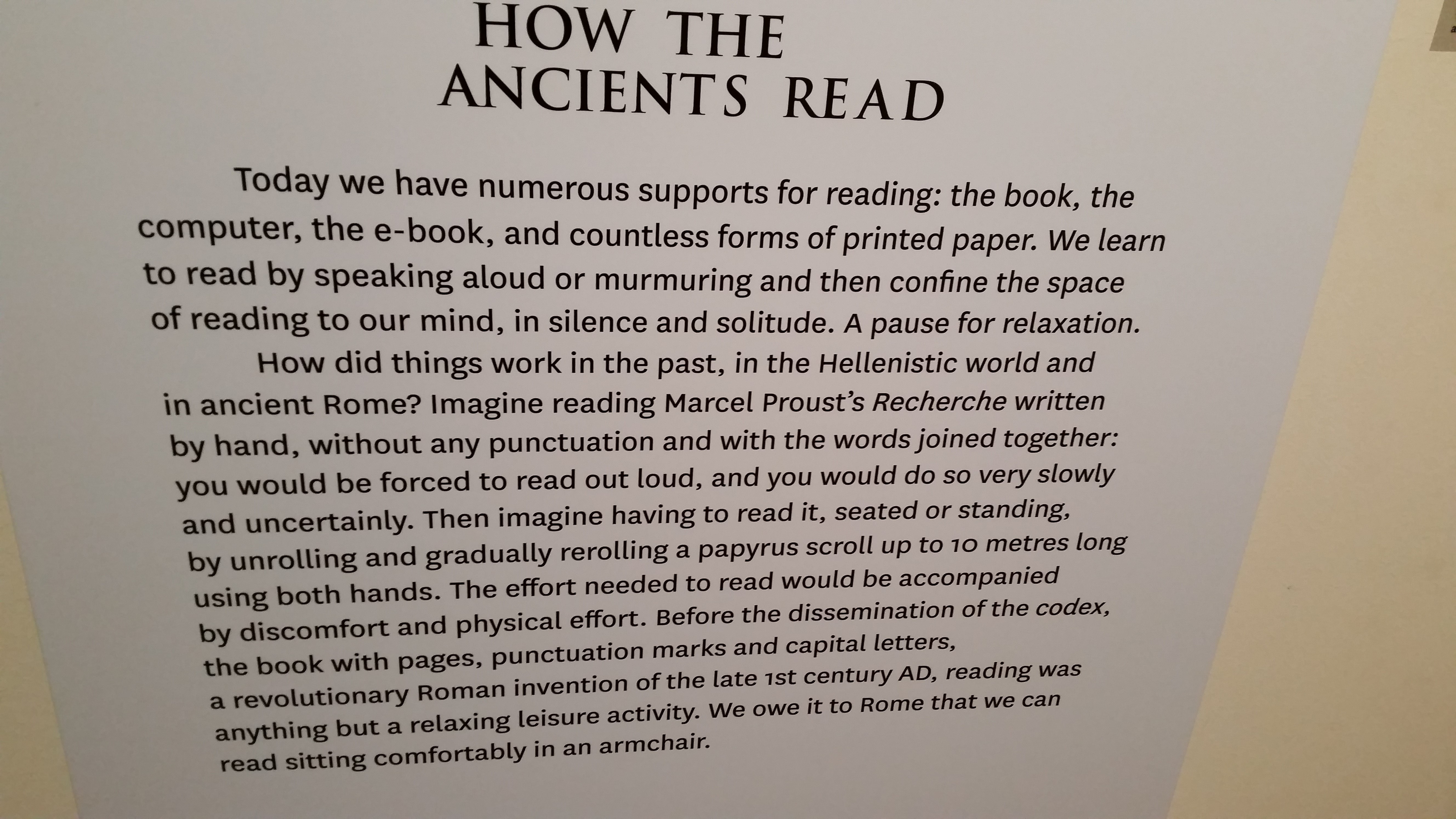
Back in the days of classical Rome, people had to work at reading. They didn’t have books lying around their homes — at least not according to the exhibit about libraries that I saw at the Colosseum. They had to go out to reach their reading material at a library or gymnasium. Then, they had to unroll and re-roll long papyrus scrolls written without any punctuation, capital letters, or even breaks between words, according to a Colosseum exhibit about ancient libraries (see “How the Ancients Read” photo).

How the Ancients Read

Click to read “How the Ancients Read” in a larger format.


Can you imagine reading this blog post under such conditions? I had a somewhat similar experience—in terms of the lack of punctuation at least—when I studied classical Japanese at Harvard way back when. It took a lot of effort to work my way through edicts of the Tokugawa shogunate.

I think that the difficulty of reading in the days of Rome or classical Japan might have spurred me to abandon books even faster than I do now. These days I drop novels that don’t grab me in the first 40 pages. I may not go beyond the first paragraph of a blog that fails to sparkle.Rome Colosseum library exhibit

However, on the other hand, I imagine the scarcity of reading materials in classical Rome would have lowered my standards for what was worth reading and how long I’d read it. When I was a girl, I read all of my brother’s Hardy Boys and many of his science fiction books. They weren’t my favorites, but I was a voracious reader who couldn’t get enough books from the library.

Things sure are different today. My favorite smartphone app is the Kindle app that lets me carry a book everywhere. While it’s great that reading is more accessible, I’m a little sad that this makes reading less of a privilege.

What does the difference between ancient Rome and today mean for you as a writer? It’s a reminder that you must work hard to keep your readers’ attention because it’s so easy for them to take advantage of other options.

Guest bloggers: 2014 in review

Looking for marketing and writing tips from diverse experts? Check out the posts from my 2014 guest bloggers listed below!

Blog

Marketing

Social Media

Writing

Time to think as a writer’s technique

Is taking time to mull over your topic one of the best things you can do to succeed as a writer?

The following quote from Rudolf Flesch’s chapter on “The Shape of Ideas” in The Art of Readable Writing set me to thinking:

Every professional writer knows that this period of just-sitting-and-thinking between legwork and outline is the most important part of the whole writing process.

I know that I write better when I let the ideas marinate in my head before I write. Distance from the content gives me perspective. As Flesch notes in a different chapter, “… the unconscious mind is so much better at combining ideas in a novel way. It puts together things that we would never put together in our ‘right mind.’” However, simply walking away from the material may not be enough. In “The Shape of Ideas,” Flesch suggests two ways to jumpstart your thinking.

1. Tell someone

Flesch suggests that you talk through your topic with a member of your target audience. Your goal should be to figure out one sentence or phrase that captures your main point. If you do this, “Everything else will arrange itself around this one sentence or phrase almost automatically, says Flesch. In other words, the sentence becomes like a “elevator speech” for your writing.

I think talking things through with a member of your target audience is helpful because they add a perspective you lack. They’ll tell you what really interests them. They’ll also cue you into words or concepts that you need to explain better.

2. Write about a “typical person” or common theme

“Whenever you’re writing about a group or an organization, … focus on a typical member of the group. Start by describing him (or her) and go on from there,” suggests Flesch. You can use this technique to organize your thoughts. For example, you could write about a typical member of a 401(k) plan. Flesch warns that you should be careful to pick someone who’s truly typical, instead of a flashy outlier.

If you’re not writing about a group, look for some other common denominator, suggests Flesch. It could be an event that’s a turning point or some sort of theme

My take on finding the key idea

If you lack the time to mull over your topic—and if Flesch’s ideas don’t apply—what can you do?

My favorite approach is to draw a mind map of my ideas for the piece, whether it’s a blog post, white paper, or even a book chapter. Mind mapping is a visual, non-linear brainstorming technique that I discuss extensively in my book, Financial Blogging: How To Write Powerful Posts That Attract Clients and in posts on this blog, such as Photo + Mind Map = Blog Inspiration. I felt as if mind mapping saved my sanity when I wrote complex articles with a dozen or so sources for trade magazines. The birds-eye perspective offered by mind maps helped me find patterns in the apparent chaos of data.

If mind mapping doesn’t appeal to you, try freewriting, which I also discuss in Financial Blogging. Basically, you write for a limited period—perhaps 10 minutes—about whatever pops into your head on your topic. Then, you pause to analyze what you’ve written. This should help you to find themes.

What works for YOU?

Different techniques work for different people. If you’ve found a great technique that I haven’t mentioned here, please share it.

I like it when people share things with me. I discovered Flesch’s book because Doug Tengdin (@tengdin) told me about it. Thanks, Doug!


Disclosure: If you click on the Amazon link in this post and then buy something, I will receive a small commission. I only link to books in which I find some value for my blog’s readers.

Financial website writers, match headlines to content or lose readers

Your web pages should deliver on the promise made by your headlines. That doesn’t happen in the economic commentary example shown below (with company name blacked out). 

Economic commentary example

Let’s look at what went wrong, so you can avoid these mistakes.

1. Most of the paragraph is unrelated to the headline

A Wall Street Journal report about bank surcharges has nothing to do with the headline topic of “Emerging Markets Continue Impressive Growth While Developed Markets Continue Recovery.” Emerging markets don’t enter the picture until the last two sentences of the paragraph.

2. Too-long paragraph lacks WIIFM and topic sentence

The paragraph is so long and dense that it’s likely to scare away all but the most motivated readers. Writing for the web demands that short chunks replace massive blocks of information. The content doesn’t explain its WIIFM—what’s in it for me. To catch busy readers’ attention, you need to make it clear why they’ll benefit from your content. For example, will you help them to understand why emerging markets’ growth will outpace that of developed markets, making them an important component of a diversified portfolio? The example in the image above fails the WIIFM test.

The paragraph also lacks a strong topic sentence that introduces its overall topic. To me, it reads as if a person saw an interesting article in The Wall Street Journal and spouted reactions off the top of his or her head, and then moved on to a Financial Times article and, finally, a thought about the emerging markets.

3. The graph isn’t supported by the text

The “World Economy — Gross Domestic Product (GDP)” graph in the web page’s image doesn’t relate to the accompanying text. A good writer would have related the headline and the graph in his or her text, instead of rambling about banking.

How to fix this page?

Fixing this page would require one of two approaches. First, throw out all of the text, except possibly a revised version of the last two sentences, and create new content focused on the growth of emerging vs. developed markets, as shown by the graph, other data in the clickable link, and other evidence.

The second approach would require throwing out the current headline and graph to focus on the implications of the Fed’s capital surcharge. The banking text would need a drastic rewrite to become more focused and less flabby.