3 fixes for lousy quotes in your financial writing

Quotes are a great way to add oomph to your writing. This is true whether it’s a short piece, such as a blog post, or a long white paper for your investment or wealth management firm. But what if you’re quoting lousy writers or interviewees who haven’t expressed themselves well?

Quote fix 1. Rewrite the quotes

Rewriting can be controversial.

lousy quotesSure, no one will protest if you add or delete a comma in a sentence. No one will even notice the difference between the mispunctuated “He said ‘Thank you’ ” and the correct “He said, ‘Thank you.’ ” You can even change “average annualized returns” to “annualized returns,” removing the redundant “average.” I think most people are fine with small tweaks that don’t change the meaning of the person who wrote or spoke the words.

However, purists would say that you should reproduce written materials word for word or note changes, for example, by inserting ellipsis (…) to show where you’ve deleted even one word. “Quotations must be identical to the original, using a narrow segment of the source. They must match the source document word for word and must be attributed to the original author,” says the Purdue Online Writing Lab.

People also agree that you can’t make radical changes and still call something a quote. Here’s a before-and-after example where no one would call the “after” a quote. This example originally appeared in “Seven Ways to Talk Your Financial Execs Out of Jargon and Bad Writing, ” my guest post on MarketingProfs (registration required):

BEFORE:

Proposals from the German/French axis in the last few days have heartened risk markets under the assumption that fiscal union anchored by a smaller number of less debt-laden core countries will finally allow the ECB to cap yields in Italy and Spain and encourage private investors to once again reengage Euroland bond markets. To do so, the ECB would have to affirm its intent via language or stepped up daily purchases of peripheral debt on the order of five billion Euros or more. The next few days or weeks will shed more light on the possibility, but bondholders have imposed a “no trust zone” on policymaker flyovers recently. Any plan that involves an “all-in” commitment from the ECB will require a strong hand indeed.

AFTER:

Prices of riskier investments rose in response to recent proposals by German and French leaders, but we are skeptical that this will continue. Investors seem to believe that the proposals will strengthen the euro zone by capping bond yields. This would make euro-zone bonds more attractive to private investors. However, success would require the European Central Bank (ECB) to use strong language or to boost its daily purchases of the troubled countries’ debt by at least €5 billion. To convince distrustful investors will require strong action. That may be more than the ECB can achieve.

Things get murky in the middle ground between tiny tweaks and massive rewrites. Many of my writer friends say that it’s fine to smooth out quotes when your interviewees express themselves poorly in a live interview. However, reporters have gotten into trouble for taking this too far. Have you noticed how some question-and answer stories now come with disclaimers? For example, the “Talk” column in the magazine section of The New York Times says, “Interview has been condensed and edited.”

Edits are particularly risky when the editors don’t know the topic well. They may unwittingly change the speaker’s meaning.

Edits are less risky when they will be checked for accuracy by the speaker or author. This tends to happen more when a company interviews or uses source materials from an employee.

Quote fix 2. Paraphrase the quotes

Paraphrasing is an underutilized tool, in my opinion. Paraphrasing means taking the words of the speaker or author and summarizing or rewording them without quotation marks, but still attributing them to the source. This is a great way to streamline sentences so they focus on the expert’s main message.

I’ve seen too many writers string together quotes to form an article. These articles are held hostage by their experts’ wording. As a result, they often lack the connective tissue that makes an article flow well.

“If you can say it better as a paraphrase, the quotes are probably not that strong,” as The Associated Press Guide to News Writing notes.

Quote fix 3. Delete the quotes

Some information doesn’t deserve quotation marks and a source. Do you need a sentence along the lines of ” ‘There are 50 states in the United States of America,’ says Jane Doe”?

You can share common knowledge without attributing it to anyone.

What’s YOUR take on fixing quotes?

I’m always interested in what you think about the writing questions that I pose on this blog. Please chime in.

Image courtesy of kibsri/FreeDigitalPhotos.net


Note: This post was updated in December 2022.

Stop being happy–and win more readers

Does the following sentence inspire you to dig into the writer’s newsletter?

The XYZ Financial team and I are happy to bring you this month’s newsletter.

It doesn’t inspire me. I doubt it inspires you. However, I often see financial professionals start their emails, letters, and newsletters with similar sentences. If they’re not “happy,” they’re “pleased,” “delighted” or something similar. This is so wrong. Stop being happy!

Why to stop being happy

stop being happyPlease stop talking about how great your content makes YOU feel.

Unless you’re writing to close family members or friends, no one cares about your emotions. They care about WIIFM—what’s in it for me, your reader. When you talk about your happiness you sacrifice the opportunity to appeal to their WIIFM.

In addition, focusing on YOUR emotions may make you seem self-centered or self-important. It’s as if you’re saying, “We are great. Bow down at our feet and worship us.” Okay, I’m exaggerating. Still, I hope you get the idea that I’m trying to communicate.

Your alternative to being happy

How else can a writer open their message? Start with something that solves a problem that your reader has. This will appeal to their WIIFM.

For example:

Curious about how the new tax law affects you? Avoid problems with the IRS by learning about the three things you may need to do differently, as covered in this month’s newsletter.

In addition to focusing on the reader’s WIIFM, this new introduction also gets to the point quickly. That’s essential to grabbing the attention of readers whose email inboxes are overcrowded.

Not sure how to identify your unhappy topic?

If you have trouble identifying your readers’ problems, read “Identifying ‘WHAT PROBLEM does this blog post solve for them?’” The same issues apply to blogs and newsletters. In fact, today’s newsletter articles often originate as blog posts.


Stop being happy and start attracting more readers and clients!

Image courtesy of stockimages/FreeDigitalPhotos.net

“Deep Work” rules to help you write more

Many people struggle to write as much as they’d like. This is especially true if the writing isn’t a core part of your job. I found some rules that may help you when I read Deep Work: Rules for Focused Success in a Distracted World by Cal Newport.

What is “deep work”?

deep work carl newport book coverHere’s how the author defines “deep work”:

Professional activities performed in a state of distraction-free concentration that push your cognitive capabilities to their limit. These efforts create new value, improve your skills, and are hard to replicate.

It’s clear to me that writers will benefit from this kind of concentration. How do you achieve it? One way is to develop rituals that signal to you that it’s time to focus.

I suggest that you create rules to answer the questions that Newport says must be addressed by an effective deep work ritual.

Rule 1. Pick a location for your deep work

Newport asks you to pick a location for your deep work. As he says, “If it’s possible to identify a location used only for depth—for instance, a conference room or quiet library—the positive effect can be even greater.” But you might be able to get away with working in your usual work place if you can set other rules to help you focus.

I think that being in a different location is one reason why I’ve been so successful with blogging on vacation, as I discussed in “No batteries required: My favorite blogging technique.”  When I’m not on vacation, I do most of my blog post writing either on steno pads, which I can use anywhere, or at my PC, which plunks me down in my office.

Rule 2. Pick a length of time for your deep work

“…give yourself a specific time frame to keep the session a discrete challenge and not an open-ended slog,” says Newport.

I have tried a variation on this by committing to work for a minimum of 15 minutes, as I discussed in “15 minutes to busting your writer’s block.” I haven’t tried putting a limit on how long I can work. That simply hasn’t been a problem for me. However, I can see how it would help some people to know that they need not continue working beyond their predetermined limit.

Rule 3. Limit distractions during your deep work

For example, this could mean closing email and blocking social media during your deep work.

Rule 4. Support yourself

Newport says this could mean you “start with a good cup of coffee.” It also means creating an environment that supports your work by keeping necessary supplies handy. Newport says, “…this support needs to be systematized so that you don’t waste mental energy figuring out what you need in the moment.”

I love Newport’s line about “…don’t waste mental energy figuring out what you need in the moment.” I think that’s one of the biggest benefits of any rituals or systems that help you to write.

For me, the support for my blogging means having a handy list of potential blog post topics so I never have to start from scratch.

For some writers, it might mean always starting from the most recent stopping point in your work, as I discussed in “Break your writer’s block with Robert Benson and Eric Maisel.”

What rules help you to do deep work?

If you’re achieving deep work, what rules work for you?


Disclosure: If you click on the Amazon link in this post and then buy something, I may receive a small commission. I only link to books in which I find some value for my blog’s readers.

Test your financial editing skill with these examples

Savvy editors can boost the effectiveness of financial content by streamlining it. Hone your financial editing skill by reviewing the before-and-after examples I share below. Some of the “before” examples are taken directly from my reading. Others are inspired by my reading, but tweaked.

I’ve grouped the examples by the main lesson that they illustrate. If you’re hungry for more examples, see “Can YOU simplify investment commentary better than this?” You can learn more more tips and techniques for financial editing in my book, Financial Blogging: How to Write Powerful Posts That Attract Clients.

If you can improve on my edits, please let me know. Sometimes an editor with a fresh eye can make improvements.

1. Delete or replace forms of the verb “to be”

edit financial writingBefore: The company’s 2015 loss is a reflection of the shifting preferences of consumers for ordering online instead of going into a store to buy.

After: The company’s 2015 loss reflected consumers’ shift toward buying online instead of in stores.
Note: “Is a reflection of” becomes “reflected,” as you replace a “to be” verb plus noun with the verb form of the noun.

Before: This data is supportive of higher prices.
After: This data supports higher prices.

Before: Stocks as expensive as these are often experience price declines.
After: Stocks this expensive often fall in price.

Before: This kind of growth could be sustainable going forward.
After: This growth could continue.
Note: I imagine that in either version, the next sentence might discuss what will drive the continued growth. I believe the writer is trying to say something with the adjective “sustainable.”

2. Delete “the fact that,” “it should be noted that,” and similar phrases

Before: We are pleased with the fact that the company’s profitability is improving.
After 1: We are pleased with the company’s improving profitability.
After 2: The company’s profitability is improving
Note: Phrases such as “the fact that” don’t add anything useful to the sentence. “We are pleased with” sounds self-congratulatory. I prefer to simply present the information.

Before: It should be noted that boom and bust cycles for oil tend to be long lasting and we have been talking about the end of this cycle for some time now.
After: Oil’s boom-bust cycles tend to last a long time, but this boom is already long.
Note: The rewrite also benefits from using the possessive. Using “but” instead of “and” makes the relationship between the two clauses easier to grasp.

Before: We have seen stocks that have failed to live up to expectations.
After 1: We have seen stocks fail to live up to expectations.
After 2: We have seen stocks disappoint expectations.
After 3: We have seen stocks disappoint.
After 4: Some stocks disappointed.
Note: This four-step revision shows how it can help to keep looking for ways to streamline your sentences.

3. Say what you think, not what you don’t think

Before: We do not think it is a coincidence.
After: We think it resulted from a plan.
Note: Say what you think. Don’t make people struggle to figure it out by analyzing what you don’t think.

4. Use the possessive to shorten

Before: The type of actions that Jeb Bush is taking might not seem strange to Republicans
After: Jeb Bush’s actions might not seem strange to Republicans.

5. Replace “result”

Before: These changes resulted in cost savings.
After: These changes cut costs.

Before: These changes resulted in revenue growth of 74%.
After: These changes grew revenues by 74%.

6. Remove excess words

Before: The recent sell-off in the small-cap stock market has created an attractive window of opportunity to invest in the sector.
After: Their recent sell-off has opened a window to invest in small-cap stocks.
Note: It’s clear from the context that a “window” is an attractive opportunity to invest.

Before: There has been a proliferation of new entrants into the social media analytics space.
After 1: Many new companies have started offering social media analytics.
After 2: Many new companies offer social media analytics.
Note: Try to replace nouns, especially multi-syllabic words such as “proliferation,” with verbs.

Before: The company has strong preexisting relationships with wholesalers.
After: The company has strong relationships with wholesalers.
Note: I don’t think you would make the mistake of assuming from the new sentence that the company has anything other than preexisting relationships with wholesalers, unless this is in the context of writing about something that brings new relationships.

Before: Mergers & Acquisitions (M&A) was a major theme in 2015, as transactional activity accelerated during the year led by many
prominent investment firms.
After: An increase in mergers and acquisitions (M&A), led by major investment firms, made M&A a major theme in 2015.
Note: This sentence was hard to simplify out of context. I might have chosen differently if I saw the entire paragraph. However, sometimes you can streamline by simplifying adjectival phrases. “Transactional activity” becomes “transactions.” Limit the number and length of adjectives. “Many prominent investment firms” becomes “major investment firms.” Avoid random capitalization, as in “Mergers and Acquisitions.” Letters that are capitalized in acronyms, such as M&A, shouldn’t be capitalized when the words are spelled out in full.

Before: The company was two times the size of its smallest competitor.
After: The company was twice the size of its smallest competitor.

Tips for refining your financial editing skill?

Editing other people’s drafts is a great way to improve your skill as a financial editor and writer. You can also take classes to get more practice. If you have other tips for improving your financial editing skill, I’d like to hear them.

Image courtesy of bplanet / FreeDigitalPhotos.net

5 rules for using quotes in investment commentary

Smart investment commentary writers are willing to learn from others. That’s why I was delighted when Rob Martorana shared the thoughts below in response to my post, “Should you use quotes like Bill Gross?” His rules about using quotes deserve wider circulation.

By the way, this blog post is a testament to the power of LinkedIn for connecting people. I met Rob thanks to the serendipity of his commenting on one of my earlier status updates on LinkedIn. This is a great reason to be on LinkedIn.

5 rules for using quotes in investment commentary

By Rob Martorana

I agree that quotes should not be “teaser” content. If Bill Gross opened his article by quoting “When I’m 64,” the article should be about aging. Authors should use quotes carefully, and always with their audience in mind. Here are five rules I try to live by:

Martorana_headshotRule #1: Do not quote ancient philosophers when the market is crashing.

That annoys clients to no end. Investors do not want to hear from Sun Tzu and the Art of War after they just lost $100,000.

Rule #2: Do not quote people out of context.

Show that you understand who said it, when they said it, and what they meant by it. Don’t put words in the mouth of the person you are quoting.

Rule #3: Do not quote out of cowardice.

If you want to say something controversial to the audience, just come out and say it. Don’t hide behind the authority of a historical figure.

Rule #4: Keep your wit on a short leash.

Quotes are often used to entertain and amuse, rather than to illustrate and illuminate. This is related to rule 5…

Rule #5: Get to the point quickly.

Remember that “brevity is the soul of wit.”

Investment writing should be clear, concise, and concrete. Don’t take me down a rabbit hole to show off your knowledge of Milton Friedman or Michel Foucault.

Rob Martorana owns an RIA in New Jersey, where he manages money, publishes articles, and provides competitive intelligence on the wealth management industry. His research interests include portfolio design, expected returns, liquid alternatives, and the digital delivery of investment advice.

Capitalize titles consistently in your publications

What’s the best way to capitalize a title when you write an article, blog post, book, or other publication? The rules vary. The best thing is to pick one approach and stick with it.

Option 1. Use sentence case when you capitalize titles

capitalize titles in typing publicationsI’m a big fan of using sentence case for capitalizing titles. “Sentence case” means that you only capitalize the first letter of the first word of the title, just as you’d do in a sentence. This is easy to remember. Plus, it doesn’t require judgment calls about which words deserve an initial capital. That’s its big appeal in my eyes.


However, sentence case looks funny in book titles. I didn’t use sentence case in the title of my book, Financial Blogging: How to Write Powerful Posts That Attract Clients. Perhaps that’s why the alternative to sentence case is called “title case.”

Other approaches to capitalizing titles

The alternative, title-case approaches amount to this: Capitalize the initial letter of every word in the title except for minor, helper words.

The complicated part is deciding which words are too unimportant to earn an initial capital. Typically “the” and “an” don’t make the cut. Prepositions are a bit trickier. Check your favorite style guide or use the online tool I mention in the next section.

For example, my old copy of The Chicago Manual of Style says to “Lowercase articles (the, a, an), and subordinate conjunctions (and, or, for, nor) and prepositions regardless of length, unless they are the first or last words of the title or subtitle.” I know of at least one investment management firm that uses the style guidelines of the American Psychological Association (APA). The APA’s guidelines for title case differ somewhat from the Chicago guidelines, as do the Associated Press guidelines.

A handy tool for capitalizing titles

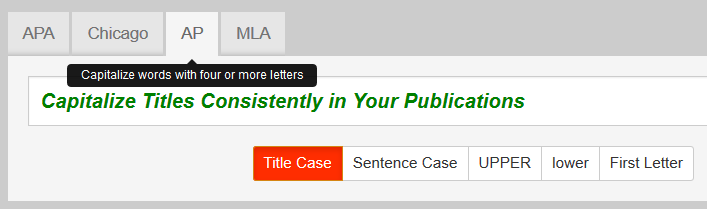
CapitalizeMyTitle.com is a handy tool that will capitalize your title according to the rules of the style guide you choose. Just type in your title and click on the tab of your preferred style.

CapitalizeMyTitle.com shows you how to capitalize titles

Laptop image courtesy of blackzheep/FreeDigitalPhotos.net

Rev up with my Daily Writing Challenge!

Do you struggle to write as much as you would like? I sometimes have that problem, too. When I was in a slump last year, I found a solution in a daily writing challenge on Facebook. To help me keep up my writing, I’m inviting you to join me in a daily writing challenge during the month of April.

Daily Writing Challenge rules

Here’s how it works:

  • You set a goal of averaging X words/day during the month. Note: it’s an average. You don’t have to write that amount every single day.
  • You check in daily on the Investment Writing Facebook page for accountability and encouragement.
  • People who reach their goal for April get the right to brag. I’ll trust you to report your success honestly.

What to share when you check in

What do you write in your daily check-in? You can

  • Share your word count for the day
  • Post your intention for the next day
  • Share a tip for writing despite leading a busy life
  • Ask for encouragement or helping in cracking a writing challenge
  • Encourage others

It’s up to you to choose what you share. I don’t want to ensnare you in complicated rules. I’d like this challenge to work for you.

If it works for me, it might work for you

I find that accountability to an individual or group is very motivating for me. As I mentioned in “How a blogging buddy can help your financial planning or investment blog,” I have a goal buddy with whom I check in weekly by phone. That has been invaluable.

I’ve been working with a goal of averaging 300 words daily on my blog and other non-routine, non-client writing. I hit my goal in December, January, and February. I’m not sure that I’m going to make it in March. That’s partly why I’m recruiting you to join me in my April challenge. I also figure it’s a good way to encourage the students who recently completed my financial blogging class to keep on writing.

I find that setting my intention—for example, a word count goal or planning to work on a specific blog post—the evening before my work day helps me to deliver. Also, it means that I don’t approach my computer with a blank mind. My first step is clear when it’s time for me to tackle my daily word count.

daily writing challenge

My partial date and word count record from Feb. 2016

When it’s time to pick a topic to write about, I can go to the Microsoft Outlook task list where I keep a list of potential blog post topics.

I also appreciate the support of others who struggle with keeping up the writing despite the demands of our work and personal lives.

To help me track my word count, I enter my word count daily in an Excel spreadsheet. I mostly write on a computer, so it’s easy for me to generate an accurate word count. If I were writing longhand, I’d use the old-fashioned trick of counting the number of words on three lines, calculating the average number of works per line, and the multiplying the number of lines times the average word count per line. It’s less time-consuming than counting word by handwritten word.

Declare your intention to participate in the Daily Writing Challenge!

If you’d like to participate, go to the Investment Writing Facebook page and declare your intention on this post.

Then, on April 1, post what you achieve for the day. Although April 1 is April Fool’s Day, this is no joke. I hope you’ll join me.


Note: I edited this post on Nov. 28, 2016, when I tweaked the rules of the challenge.

Force yourself to write or wait for inspiration?

Procrastination can be good. That is the startling point of “Why I Taught Myself to Procrastinate,” an opinion piece in The New York Times. Its author, Adam Grant, a professor of management and psychology at the Wharton School, argues that procrastination “is a virtue for creativity.” His article made me wonder about writing. Should you always force yourself to write, or is it sometimes better to procrastinate, to wait for inspiration?

Let me confess. I take writing deadlines seriously. I finish my projects early whenever possible. I’m not a fan of waiting for inspiration, which is my personal definition of procrastinating about writing. However, in this article I consider both sides of the story.

Why procrastinate?

lightbulb idea writing inspirationGrant’s interest in procrastination was inspired by one of his graduate students. “She told me that her most original ideas came to her after she procrastinated,” says Grant. He and his student tested whether her experience applied more broadly. Their experiments suggested that “procrastination encouraged divergent thinking.” Why? Because it gives us a chance to move beyond “our first ideas, which are usually our most conventional.”

Of particular interest to writers, Grant reports on his experiment in procrastinating about writing his opinion piece about procrastination. Here’s what he found:

What I discovered was that in every creative project, there are moments that require thinking more laterally and, yes, more slowly. My natural need to finish early was a way of shutting down complicating thoughts that sent me whirling in new directions. I was avoiding the pain of divergent thinking — but I was also missing out on its rewards.

Clearly, procrastination sometimes pays. Still, what Grant described doesn’t fit my definition of procrastination. I think of procrastination as putting off beginning work on a piece. Instead, Grant focuses more on not finishing a piece at the earliest opportunity. In fact, he started thinking about the piece early, giving him time to come up with new ideas for it. To me, that’s a form of preparation for writing. It’s productive procrastination, unlike the unproductive procrastination of people who wait until the last minute to do any work at all on their projects.

Why you shouldn’t wait for inspiration, but can delay final draft

When my schedule permits, I like the idea of starting early but delaying the final draft. This is especially true for my creative work, such as blog posts. It is in line with what Grant suggests. I found evidence supporting this in Wired to Create: Unraveling the Mysteries of the Creative Mind by Scott Berry Kaufman and Carolyn Gregoire. The authors describe Picasso’s creative process:

Exploration and seemingly blind experimentation were key to Picasso’s creative process. Rather than creating a painting to reflect his own pre-existing worldview, he seemed to actively build and reshape that worldview through the creative process. While he may have had a rough intuition, it’s likely Picasso did not know where he was going, creatively, until he arrived there.

I also like the idea of “creative incubation,” discussed in Wired to Create.

Many of us know from experience that our best ideas come seemingly out of the blue when our minds are off wandering elsewhere. Idle though it may seem, the act of mind wandering is often anything but mindless. Research suggests that an incubation period of mind wandering leads to improvement in creative thinking. The next time you’re working on a creative project or work assignment that requires intense focus and creative chops, try taking a five-minute daydreaming break every hour or so, and see how it affects your ideas and thinking. During this break, engage in a simple activity that will allow your mind to wander, like walking, doodling, or cleaning. Consider this your creative incubation period and see if you feel a renewed sense of creative energy when you get back to work.

Why force yourself to write?

One reason to force yourself to write is that waiting until your deadline nears is stressful. I regularly see my writer friends on Facebook lamenting their last-minute pressures as they hustle to finish articles that they put off until the last minute. Sometimes they lose face with their editors when they ask for extensions.

Another reason to force yourself to write is that “Research has shown that waiting for inspiration doesn’t work,” according to Paul J. Silvia in How to Write a Lot: A Practical Guide to Productive Academic Writing. He reports on a research study that tested the effectiveness of three different writing strategies:

  • Abstinence, in which subjects “were forbidden from all non-emergency writing”
  • Spontaneous, in which subjects scheduled writing sessions “but wrote only when they felt inspired”
  • Contingency, in which scheduled writing sessions “and were forced to write during each session,” plus “they had to send a check to a disliked organization if they didn’t do their writing

People in the contingency group wrote far more than their peers in the other two groups. In addition, people in the contingency group reported fewer days between creative ideas than members of the other two groups, according to Silva.

Can you be creative without delay?

There’s a difference between procrastinating and taking time to prepare before you write. I believe in starting your writing early enough that you can spend time brainstorming, using techniques such as mind mapping or freewriting. When you start your draft early enough, you can let your ideas marinate.

Don’t wait for inspiration. Instead, start thinking early about your article. Follow a process to develop your ideas, write your draft, and edit. Most people will find they like the results and experience less stress.

Of course, we all have different personalities. I’m sure there are people who enjoy last-minute crunches that they’ve created for themselves. Just as there are things that I do that no one else would want to impose on themselves. Find the solution that works best for you.

Image courtesy of lekkyjustdoit / FreeDigitalPhotos.net

Financial jargon killer: The Wall Street Journal

“How can I talk my boss out of using financial jargon?” I hear variations on this question from my clients and blog readers. I’ve already written “Seven Ways to Talk Your Financial Execs Out of Jargon and Bad Writing” (registration required) for MarketingProfs. But recently I thought of a new idea to help you rein in the worst offenses by your firm’s lovers of complex language.

Here’s my idea. Ask “What would The Wall Street Journal do?” We can call this technique WWTWSJD for short, in a nod to other “What would ____ do?” strategies.

I suggest that you use WWTWSJD because most financial professionals read The Wall Street Journal. More importantly, they respect the newspaper. They don’t feel that it treats them as stupid. Thus, if you show them that the Journal wouldn’t use a piece of financial jargon, they might listen to you.

Step 1. Identify financial jargon for review

"Smart beta" jargon search results from The Wall Street Journal

Search results for “smart beta” in The Wall Street Journal

Identify the piece of jargon that you’d like to eliminate from your firm’s publications. Then search to see if The Wall Street Journal uses it.

Take a technical term like “convexity,” which is used in the world of fixed income. When I searched it on the newspaper’s website, I discovered that “No articles or videos have been found.”

How about “smart beta”? I found only three results. That result also suggests that the term isn’t widely understood.

Step 2. Dig deeper into the jargon’s usage

Let’s look more closely at the newspaper’s use of “smart beta.”

It uses the term, but quickly defines it. For example, here’s how Ari Weinberg treats the term in the first two results (emphasis added):

  • Even the more-complex “smart beta” or factor-based ETFs, which weight holdings according to an investment factor such as volatility or value instead of market capitalization, are able to manage constituent changes to minimize capital gains.
  • ‘Smart beta,’ in particular, creates real due-diligence problems,” Mr. Nadig says, referring to the growth in index products that shun traditional market-cap weightings and instead weight holdings according to an investment factor such as volatility, value, quality or momentum.

The third article using “smart beta” was written by one of the outside contributors to the newspaper’s “Ask the Experts” section. It seems to be considered as a blog post, based on a disclaimer on the comments page. I imagine that those pieces aren’t edited as rigorously for jargon as the pieces written by staffers. The editors let the outside contributors write in their own style.

Step 2a. Cross-test jargon with The New York Times

While I like the idea of using The Wall Street Journal to talk senior execs out of financial jargon, I’m a bit concerned about the shallowness of the archive that’s easily accessible online. The newspaper’s online search doesn’t appear to go back more than about three months. Thus, I’m checking The New York Times, another reasonably literate newspaper, because I can go back further in my search.

Here are my results for a twelve-month period:

  • Only one article used the term “convexity,” but it wasn’t used in a financial context. The article discussed the shape of a bowl scraper.
  • Four articles used “smart beta.” As you can see from the excerpts in my screenshot below, each article makes an attempt to define the term, rather than assuming the reader will understand it.
"Smart beta" results in 12-month search of The New York Times

“Smart beta” results in 12-month search of The New York Times

Step 3. Define financial jargon

If you must use financial jargon, then define it.

Need ideas about how to explain technical terms? The Wall Street Journal is a good source for explanations at a fairly sophisticated level. WWTSWJD?

For more examples of how to incorporate definitions into your writing, see “Plain language: Let’s get parenthetical.”

Caveat: Sometimes financial jargon is okay

I’m a big believer in writing using plain language. Ideally, I’d like to write more plainly than The Wall Street Journal when addressing an audience outside the financial world. Even when you’re writing for institutional investors, you may encounter readers with less knowledge than you of financial vocabulary.

However, sometimes multisyllabic vocabulary and financial jargon are more precise or make for easier communication. This is true only when you’re communicating with other highly knowledgeable professionals. For example, saying something increased by 200 basis points is more precise than saying it rose two percent. And if your readers care about measures like Sharpe ratios, there’s no substitute for using those terms.

What’s too long for a blog post?

What’s too long for a blog post? I stirred up a lively conversation when I posted this question on social media earlier this year. I asked because I’d drafted a 2,400-word blog post. That’s unusual for me. My natural length seems to be 400 to 600 words, although I’ve written longer.

As I expected, there’s no consensus on the perfect blog post length. However, you can make the decision that’s best for you, if you understand the issues.

The case for blog posts running 2000+ words

Long posts do best, as measured by shares and links. That’s what BuzzSumo-Moz research on content—that’s content of all kinds, not just blog posts—suggests, as reported in Contently’s “5 Ways Content Goes Viral.”

“Long” means way longer than the typical blog post. It means 2,000 words or more. To put that in perspective, according to Contently, “After studying close to 490,000 text-based articles, BuzzSumo and Moz found that 80 percent of content contains fewer than 1,000 words, while only 2.5 percent surpasses 3,000 words.”

The difference between shorter and longer content was dramatic. Content with less than 1,000 words averaged about 3.5 shares apiece vs. almost nine shares for content with 2,000 to 3,000 words, and 11 shares for 3,000+ words.

Evidence from financial blogger Michael Kitces

When I think about long blog posts, I think about Michael Kitces, who writes the Nerd’s Eye View blog. He shared the following graph with me, showing that long content dominates his shares. In fact, 2,000 to 3,000 words is his perfect blog post length.

Michael Kitces' perfect blog post length is 2000-3000 words

Michael Kitces’ share counts by article length. Image courtesy of Kitces.com

Here’s what Michael said to me in an email exchange about longer blog posts:

I’ve found that optimal length seems to be in the 2,000 – 3,000 word range.

We often say that people “don’t have time” to read long posts. And I suppose technically that’s true. Most people don’t. But people who have REAL problems, need REAL solutions, and might want to HIRE you, are the ones who are motivated enough to actually read a long post. And get interested. And do business with you.

So think of it this way: writing long and thorough posts is a great screening process, because it helps to ensure the people who read it are interested enough to potentially do business with you.

That’s an intriguing point about your best prospects being willing to read your long posts.

An earlier Investment Writing take on blog post length

For another perspective on blog post length, read this guest post on my blog “Do longer articles really get shared more often?

Reasons you shouldn’t go long

1. Sharing isn’t the same as reading

If you’d like people to read your content, rather than simply sharing it, shorter may be better. When people share your content, they may not have read it from start to finish. I’m living proof of that.

I confess that I’ve shared articles that I haven’t finished. Why? Because I’ve found an article that I believe will interest my followers, but it isn’t that useful to me. I read enough to find worthy content and then I skim the rest to get a sense of whether it upholds the standards of the beginning. If there’s one tip in the first part of the article that can help my connections move closer to achieving their goals, I figure it’s worth sharing.

When it comes to getting your readers through an entire post, shorter is better, unless the reader is motivated to learn about the topic you present. To support this, here are some of the comments I received in response to my asking if I should publish a 2,400-word blog post:

  • I’ve been staying under 1000 for my site….a typical newspaper column used to be about 500
  • Few blog entries I’ve edited were more than 550 words long.
  • I think it’s too long!

Several respondents suggested breaking my blog post into two parts to make it more manageable. They also made the smart suggestion that I should structure a long post to make it easy for my readers to absorb.

2. You’re not good at writing long

Don’t write long blog posts if can’t do a good job on them. You need compelling insights or strong writing skills—or both, ideally. Without them, you’ll drive away the people whom you’re trying to attract.

One person who commented on my question said, “Long posts are better if well written.” Clearly they they don’t enjoy poorly written long posts. Who would?

3. Your topic doesn’t need a long explanation

If you emphasize length over content, you’ll end up with repetitive, boring blog posts.

Your content should be “long enough to make your point,” as one of the people who commented on my blog post length question. Don’t make it longer than that.

Short can work

What if you lack the skill or motivation to write long? Don’t give up!

Short can work.

In “How Long Should Each Blog Post Be? A Data Driven Answer,” Neil Patel shares the example of Seth Godin. Godin has been tremendously successful with short posts on his Seth’s Blog. At a quick glance, his posts generally run fewer than 300 words. Many run under 100 words.

Still, if you’re not a social media visionary like Seth Godin, consider writing longer than him. Yoast, which produces an SEO optimization plugin (to help you get found in online searches) suggests in “Common sense for your website” that you aim for a minimum of 300 words:

Your page content should contain at least 300 words. That has a simple reason: would your page be a great source for the topic or keyword you want to rank for when it would only contain 50 words? Is that all there is to say about that keyword? I don’t believe that, you don’t believe that and Google does not believe that. There should be a significant amount of content for your page to be considered a great source of information.

The perfect blog post length?

What’s the perfect blog post length? It depends. The answer will vary depending on your goals, the strength of your writing and information, and the time that you have to sink into writing.

I’m going to continue to average far fewer than 2,000 words per post, despite all the research about sharing. Shorter works for me, with some exceptions.

Speaking of exceptions, I published “My experiment blogging on LinkedIn,” the blog post that sparked this discussion, with a length exceeding 2,700 words.

Please tell me what you see as the perfect blog post length.

Do you want to succeed as a financial blogger?


Blog image courtesy of Stuart Miles/ FreeDigitalPhotos.net