Guest Post: “Doctoring the Books—the Right Way”

Laura Matthews is an insightful and detail-oriented book doctor. I’ve seen her in action in my writing group. I also know one of her satisfied financial advisor clients. I’m delighted that Laura shares her perspective on book doctoring in this guest post.

Doctoring the Books–the Right Way

By Laura Matthews

Laura Matthews

“Book doctor.” Sounds intimidating. Like your worst nightmare English teacher from high school, the one who x’ed out entire paragraphs in red ink and wrote, “This paper is a rudderless boat,” under a large, scrawling “D.”

Been there.* So when I’m working with an author, I try to be as opposite as possible. In the close to 500 books I’ve edited, it’s always been my goal to encourage authors with positive feedback and storytelling savvy that enhances their material and makes it more engaging. The writer is the idea-generator; the book doctor hones that idea to razor sharpness.

A good book doctor, otherwise known as an editor, will find the gems in your work and help you polish them to a shining gleam. No matter where you are in the process—an idea, an outline, a first draft, or a thoroughly crafted manuscript—a book doctor can take you to the next level of fine-tuning and crafting the final product.

Surprisingly, the book doctor doesn’t need to be an expert in your field to be a good match. After all, if you’ve written a book, you’re the expert already. What you need is someone to let you know if your expertise is understandable to the lay person. One of the defining traits of editors is an insatiable desire to know everything. (I get closer every day.) They are curious about all kinds of topics and want to dig deep to understand them. It’s almost better when they don’t know everything about your topic; they can then bring fresh eyes to it and more effectively represent the reader. Some familiarity with the specific vocabulary of your field, though, is helpful.

What do book doctors do?

When you bring your manuscript to a book doctor for evaluation, you’ll probably get one of three recommendations:

  1. If the book is in good shape already, the editor might suggest a copy edit or proofread, to ensure there are no errors in the text itself. This type of edit covers spelling, punctuation, grammar, etc.—the mechanics of the text. If an editor suggests this right off the bat, congratulations! You’ve done an excellent job already of putting the book together.
  2. If the book is basically sound structurally but has phrasing or clarity issues, it may need a deeper line edit to smooth language, organize paragraphs, trim extra words, etc. The editor would strive to retain your voice while still ensuring the writing is clean, succinct, and understandable to the lay person.
  3. If the book has a great core concept but some organizational and structural issues, the editor might suggest a revision, which you could do with the editor’s guidance or the editor could do for you. In this type of edit, the editor connects to your ultimate vision for the project, and then does the heavy lifting for you in crafting the manuscript to your specifications without you having to be a writing expert. That’s the real expertise of the editor—crafting the written word itself.

These different levels of editing would most likely be charged at different rates, depending on the book doctor, their experience, and their availability. Some charge by the hour, others by the word count. But this is not the place to skimp before publishing or shopping your book around—one of the most common complaints today about self-published books, for example, is the carelessness or non-existence of the editing. The reader can spot it instantly. Also, many publishers are now requiring authors to have the editing done before submission. Editing is essential—don’t let your book go out without it.

The editor may have some general knowledge about what will be marketable to your audience, but your expertise will be the final word on that. You know your target market and what they need; the editor will help you say what you want to say to reach the audience you specify.

What to look for in a book doctor

Many people have strong editing skills on the page, but the bigger consideration, to me, is the personalities of the two players. Chat on the phone with the book doctors you’re considering. Do you like them? Does it seem like they like you, and are they excited about the concept of your book? You may not spend any more time with them on the phone because much of the work can be done via email, but that first verbal contact (or face-to-face if possible) is a great way to establish the tone of the working relationship.

I’ve found that the best match of author to editor comes when their communication styles coordinate. Asking something as simple as, “Do you like contact via email or phone call?” can make or break an editing relationship. Most editors these days work in Microsoft Word, using the track edits and comments, so this is another consideration. If you’re comfortable with these features, the flow of editing will be much easier.

Another important quality in an editor is diplomacy. You, as the writer, don’t have to be diplomatic, but you’ll sure notice if your editor isn’t. Editors by definition are professional criticizers, so unless they’ve learned how to give the critique with respect and empathy, it can be rough to work with them. Try to find someone who can say the tough things in a kind way. You could even ask for references to attest to this quality.

Will the book doctor find you an agent?

While it might be tempting to go with a book doctor who claims they can also get your book to market or find a publisher, I’d be wary of this promise. Editing is a particular skill set, in which the editor becomes closely involved with the words on the page at the micro level. This skill involves an eagle eye for flaws and a sharp ear for language, and takes some time to develop and hone.

Most likely, those who have become excellent editors haven’t also developed the equally demanding macro skills of marketing and sales. I do not, myself, offer any publishing services nor have I developed contacts in that direction—I focus on getting the manuscript to the best place possible, so that you, the author, can shop it for agents, find a publisher, or self-publish on your own with confidence.

Go for it!

Writing a book is the hard part. Once you’ve done that, get the right professionals on your team to bring it to industry standard. You’ll need an engaging cover, an attractive and readable layout for the interior pages, and, most importantly (in my opinion!), a strong edit. These are essential for making your book the best it can be. Then, cha-ching!, you can rack up those sales.

*I did, indeed, earn the “rudderless boat” comment on a theme paper in high school. I bear the scars to this day.

Laura Matthews of www.thinkStory.biz has thirty-plus years of working with hundreds of authors from around the globe—yet, she still doesn’t know everything. Let her edit your book so she can get that much closer to omniscience. To see how that’s going, follow her on Twitter at: @thinkStory.

Mind mapping for brainstorming as a group

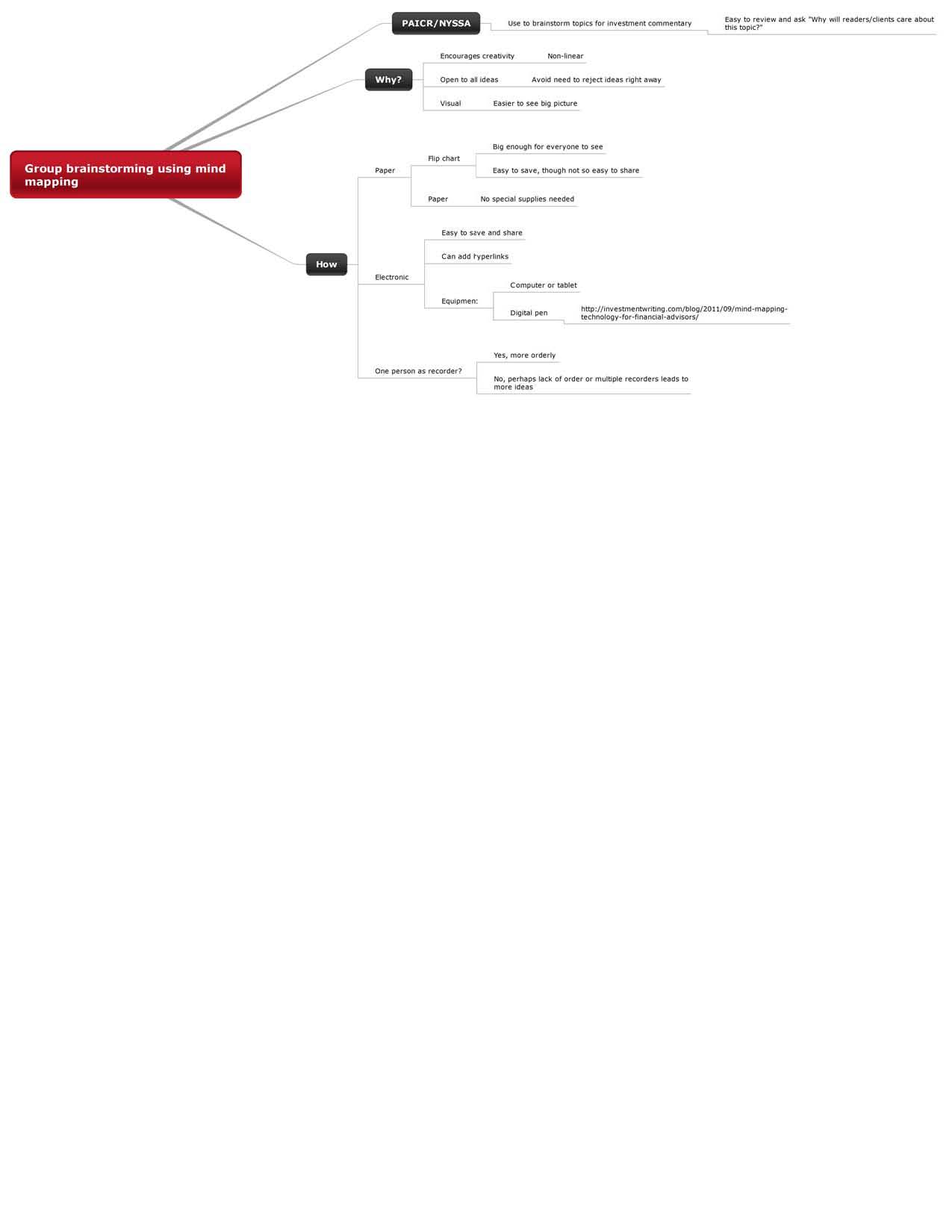
Mind mapping is a powerful tool for brainstorming. Without it, I’d find it much more difficult to write articles about complex topics. But mind mapping isn’t only for individuals. Groups can also harness its power.

“I think mind mapping would be great for group brainstorming.” It’s funny, but members of the New York Society of Security Analysts and the Professional Association for Investment Communications Resources (PAICR) made similar comments when I spoke to them about mind mapping on April 28. For example, PAICR members thought it would be a good way to discuss investment commentary ideas with portfolio managers.

I imagine a group would appoint one person to draw a mind map on a flip chart, with input from other members of the group. However, I suggest some other options in the mind map embedded below. Click on it to see a larger image.

YOUR group mind mapping ideas?

How about you? How do YOU suggest mind mapping as a group?

May 2013 update: Since I published this post, I learned that you can use mind mapping software for online collaboration. For example, I’ve shared one of my maps created in MindMeister with a client to help him brainstorm how to organize his draft. Also, here’s a MindJet video that suggests how you can use it to manage a product launch. The mind map above was created using Mindomo.

Guest post:”Using Story Telling to Educate Clients and Prospects”

Plenty of financial advisors write books to enhance their credibility. However, I don’t know many who have written fiction in their pursuit of a broader audience. In his guest post, Chuck Rylant explains why he turned to telling stories to reach clients and prospects. You may want to consider something similar for a blog post or presentation.

Using Story Telling to Educate Clients and Prospects

By Chuck Rylant

Getting and keeping your readers’ attention is incredibly difficult when you’re competing with thousands of messages from multiple media sources. It is even more difficult when you’re writing about a topic often considered dry and boring.

We in the financial planning industry often find mutual funds, interest rates and tax laws intriguing, but our clients and those who need our services often do not. Before I wrote my personal finance book, I thought long and hard how I could share a message that would stick.

I decided to take a lesson from the bestselling book of all times—the Bible—with claims of 6 million sold. It’s hard to argue with those kinds of numbers.

Regardless if you follow a faith or not, most know the story of Adam and Eve. We have all heard about the forbidden fruit and the message of temptation. We remember the lesson because it’s told as a parable.

Do you think we would remember those lessons as well if they were written as a list of rules to follow? There is such a list, but I suspect more people know the forbidden fruit lesson than can cite the list of 10. It’s far easier to become engaged and remember the lesson if it is presented as a story.

One of my more popular blog posts is a true story about my first experience in Mexico where I illustrate a point through a kidnapping. Stories can be presented as truth or fiction and have the same impact.

I used to take pride in the fact that I never read fiction, until I realized I was missing a powerful way to improve my own writing. It is certainly a skill that takes time to learn and improves with practice, but try it and watch how much more engaged your readers become.

Chuck Rylant, MBA, CFP® is the author of How to be Rich: The Couple’s Guide to a Rich Life Without Worrying About Money available at Amazon.com

Reader question: How can communicators manage difficult portfolio managers?

Investment communications professionals and portfolio managers don’t always see eye to eye on investment commentary, white papers, and other publications. But there are ways to manage business people in discussionyour differences, especially if you set expectations before portfolio managers write or even propose publications.

You asked, so I’m answering

Some of my readers asked, “What you can do when portfolio managers think their topics and writing are great, but you know they’re not?” Sometimes the experts propose topics that fascinate them, but they struggle to explain how the topics will appeal to their intended audience. Also, it’s not uncommon for experts to become engrossed in details and technical terms, but neglect to explain the big picture.

I had some ideas about how to manage these situations. And I picked up some more from my colleagues on LinkedIn, after bouncing my ideas off them. I’m quoting people only if they gave me their permission. Thank you, friends!

A five-part approach

In my opinion, there are five parts to an effective strategy for dealing with the portfolio managers.

  1. Use a process for considering topics.
  2. Create communications standards.
  3. Discuss.
  4. Edit.
  5. Get support from your boss.

1. Establish a process

Communicators can avoid conflicts by putting a process in place. As David Scales suggests, “If someone has what they think is a great idea, they should come to you first and discuss. Together, you can define the target audience…and key points to include.”

Julie Fordyce agrees, saying “If you get him thinking about these things seriously before he starts writing, then you can help him structure the paper properly at the outset and avoid the brain dump — the ‘here’s everything I know about this topic, and every chart and graph I’ve ever come up with’ problem.”

This is also the best time to squash potential white paper topics by pressing the portfolio manager about “Why will this topic interest the audience?” I like to ask “What problem does this topic solve for your readers?” and “Why will readers care about this topic?” Writer Nancy Miller says, “Investment professionals tend to think about what they know and what they want to tell. I try to get them to flip it around: What does your reader want or need to know? What’s the best way to make that happen?”

2. Create communications standards

Establishing written guidelines for your communications helps portfolio managers to understand why communications managers balk at their topic ideas and drafts. Your guidelines might be as broad as “You must establish in the first paragraph how this affects an affluent investor’s portfolio” or as nitpicky as “The plural of Treasury is Treasuries.”

I’m a big believer in explaining right away why the reader should care about the topic of any communication. If I worked on staff, I’d make that part of my firm’s communications standards. I’d also implement standards about exhibits, in addition to the usual style guidelines.

Style guidelines can defuse disagreements. Jenny L. Herring, who established style guidelines based on AP style, says, “It helped to be able to back up my guidelines with a standard reference work. It also helped when the heads of certain asset classes scheduled meetings with the portfolio managers to emphasize the importance of meeting deadlines and following style guidelines.” Support from the top always helps.

Your standards may vary depending on the audience for the final document. “Basis points” or even “bps” is fine for a time-sensitive communication between bond managers, but neither expression belongs in a document for individuals who are new to investing.

3. Discuss

Even if you have a process in place and your portfolio managers do their best to follow your guidelines, you still may run into problems. After all, portfolio managers aren’t professional writers.

This is when you should discuss the document. I suggest that communicators first say what is good about the document and then ask for help in building on the good things. Identify why the document doesn’t meet your firm’s communications standards. Criticize the piece, not the person.

I like this suggestion by Miller for dealing with portfolio managers who get bogged down in details: “I ask what they prefer to read — a document that shows the writer’s expertise or the document that gets to the point right away?”

Be realistic in your expectations. You can’t expect a busy portfolio manager to memorize your style guide. The communications professionals will probably have to do some fine-tuning before a document reaches the public.

4. Edit

Communications professionals should be prepared to edit as necessary. Do the best that you can, but you don’t have to fight over every little mistake. As Jeff McLean says, “Financial markets move too quickly to worry about a hyphen that the CEO mistakenly insisted on changing because it ‘didn’t look right.’ Recall that his or her name is on the piece, not the name of the ghostwriter or editor.” Bennett Inkeles agrees, “Do your best work, make a case for what’s right, then move on with a smile.”

Remember that sometimes the portfolio manager is right, even when their phrasing seems wrong. “I had a conversation with a financial writer who came to blows with a PM over verbiage he believed did not make sense. However, based on my experience, the verbiage in question made perfect sense,” says Inkeles.

In some cases, it makes sense to let portfolio managers sound like themselves, especially when a piece runs under the manager’s byline. “Readers want an authentic voice, not a Victorian grammar lesson,” says David Lufkin.

5. Get support from your boss

Sometimes you have to override a portfolio manager’s objections. I’d do that if a manager threw terms like duration and convexity into a piece for individual investors. In cases like this, it’s helpful to have your manager’s support.

March 11, 2013 update: I corrected a grammatical error in this piece. Yes, I make them, too.

Image courtesy of Ambro at FreeDigitalPhotos.net
Quote for writers by Maxwell Perkins

“Just get it down on paper, and then we’ll see what to do with it.”

–Maxwell Perkins

Why edit? A singer-songwriter’s reply

What can a songwriter teach you about financial communications? Plenty.

Here’s what singer-songwriter Josh Ritter says:

To edit yourself isn’t an admission of lack of talent; it’s sticking up for that talent by taking the time to make sure that everyone can understand what you’re trying to say.

I agree. Good editing will make your writing more reader-friendly.

Ritter shared his wisdom in “Seeing Red: To Write Is to Edit” in The Wall Street Journal.

Your favorite books for writers

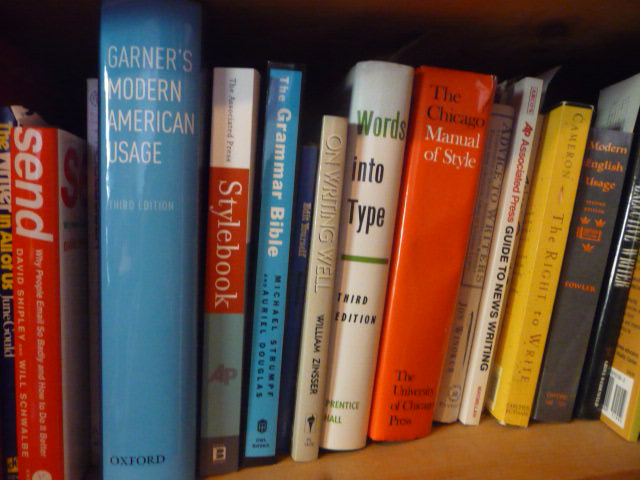
My writing books

My post on “My five favorite reference books for writers” sparked many suggestions for additional useful resources for writers.

Suggestions arrived via my blog, social media, and email. I am grateful for every suggestion.

For example, Julie Fordyce said, “In your reference book section, I’d add the New York Times Style Guide, Fowler’s Modern English Usage (even if it is British) and Theodore Bernstein’s The Careful Writer.”

You’ll find a list of books, with links to their descriptions on Amazon.com, below.

Thank you, contributors! I wish I could acknowledge every contributor by name, but even compiling the list of titles was daunting.

Dictionaries

Copywriting and marketing

More titles

I hope to work my way through the books you’ve suggested.

White papers: Great training for your ghost blogger

Busy financial advisors may seek ghost bloggers to write blog posts for them.

Photo: tomasrotger.com

As a ghost blogger for a registered investment advisor, I’ve stumbled on a great way for you to train your ghost blogger: Hire the writer to craft a white paper before she or he starts ghost-blogging.

Advantage: White paper immerses writer in your topic

White papers are usually rich in information. So one white paper provides the foundation for multiple blog posts.

I’m a big believer in recycling information, as I’ve said in “A top technique of financial advisors who blog successfully.” Your white paper readers may not even notice that you’re recycling, if your writer doesn’t simply cut-and-paste into your blog.

Another advantage: When I write a white paper, I learn about the client’s expertise, business, and how the client likes to interact with me. This means I can get up to speed quickly on the blog.

What to look for in your ghost blogger

Here are some factors to consider before you ask your white paper writer to become your ghost blogger.

1. Ability to generate blog post ideas

2. Compatibility with the way you like to work

3. Dependability

4. Mastery of a “voice” – a writing style and formality level that works for you and your audience

5. Understanding of your field

I put these five factors in alphabetical order. Your priorities may differ.

Warning for registered reps

If you’re a registered rep using a ghostwriter, you may need to disclose that. I discussed this in “Registered reps, it’s time to ‘fess up.”

Guest post: “Subject Lines: Are you reading this?”

Kristin Harad writes irresistible, conversational email subject lines. I feel as if her emails are addressed to me, so I open them even when they’re part of a mass mailing.

I’m delighted that Kristin shares her subject line secrets in her guest post.

Subject Lines: Are you reading this?

by Kristin Harad, CFP®

When you send email communications to your list, is your subject line an afterthought or a strategic decision? When I started my marketing career, I worked for an agency managing direct mail for a large bank. Unbelievable amounts of time, testing and creativity went into figuring out which 5-10 words on the outer envelope would entice the recipient to OPEN the mailing. To call the practice strategic is an understatement. Open rates were the first measure of success for these expensive campaigns.

In the new world of overflowing Inboxes, email subject lines serve the same purpose as those teasers from the old world of mass direct mail. The primary objective of your subject line is to persuade the recipient to open up your email. You may feel jaded just thinking about trying to be strategic for every subject line you send as you communicate with your database. Relax. To be deliberate with this critical ‘lure’ you just have to select the right style for your specific message and keep the words conversational.

Match your email content with one of the FOUR TYPES of subject lines:

  1. Matter of fact: “Here is the information you requested.” This kind is tried and true. You are delivering information that the reader asked for from you. Without a doubt, this type of subject line has a high open rate. As it should. These can also include compelling How To’s such as “5 ways to lower your heating bill”
  2. Time Sensitive: “Last chance! Registration closes at 5:00pm EST” “Urgent last minute teleseminar” Very effective when you actually have a deadline for an event or an offer. Beware of crying wolf! If everything is always on a deadline, you lose your credibility. Used periodically, these are quite powerful.
  3. Personal: “Kristin, have you seen this?” or the less personal “Did you see this?” A cool feature of some email service providers is the ability to pull in first name into the subject line. Tip: Questions work better than statements. People will actually think you are only asking them. Exclusivity entices.
  4. Evocative: “OMG!!!!!!!!!!!” “A harrowing tale…” Esoteric in nature, these subject lines leave the reader asking “WHAT?! I MUST know.” Try using only one word or make up a crazy word. No one can resist solving a good mystery. Curiosity drives action.

As you can see, what makes a subject line effective depends on the situation. Test out different ones to see what works best for you and your brand. Keep your eyes peeled for the subject lines that make you click and the ones that you delete. Remember, your subject line objective is to engage the reader’s interest just enough to open the email. Then it’s all up to your email copy to drive your reader’s next action.

About the Author:  Kristin Harad, CFP® is the President of VitaVie Financial Planning, a fee-only financial planning firm in San Francisco.  She offers a free video series on marketing strategies for financial advisors at http://www.next10clients.com.

Resources for quarterly investment commentary writers

If you’re about to start writing your quarterly investment performance commentary, you may find the following resources useful.