Read critically, or write badly

The two sentences below from Joe Moran’s First You Write a Sentence resonated with me. Trying to explain why bad sentences exist, he says:

The writer knew what she wanted to say, thought she had said it, and gave up reading and listening. To write well, you need to read and audit your own words, and that is a much stranger and more unnatural act than any of us know.

One problem is that what we as writers want to say is clear to us. As we skim what we’ve written, the mind fills in missing information and relationships between one sentence and another. As a result, we mistakenly think that all is well with our sentences.

How can you fight your mind’s tendency to gloss over problems when editing your own writing? Below you’ll find one suggestion from Moran, and more solutions from me.

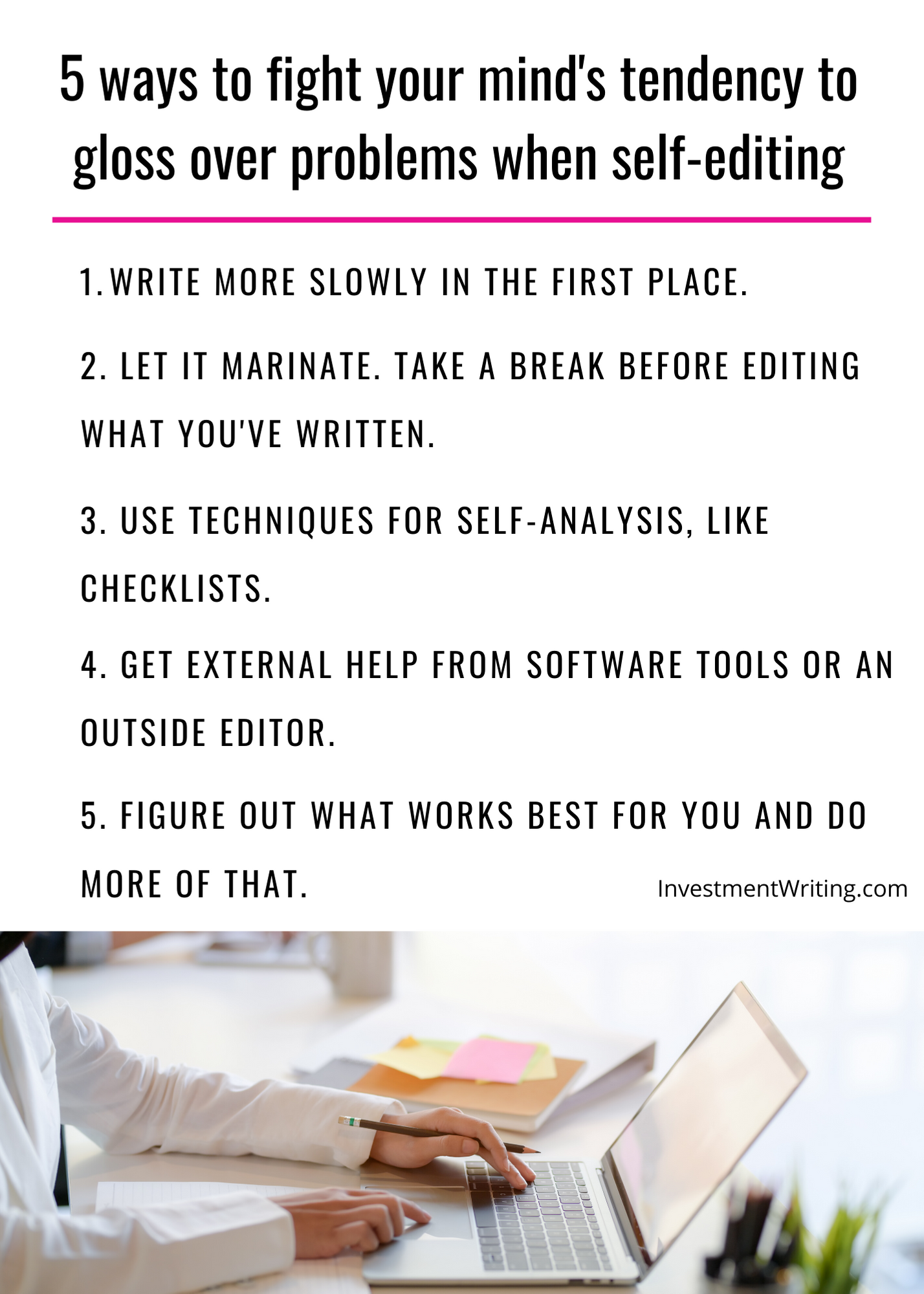
5 ways to fight


1. Write more slowly in the first place

Moran says:

Most of us, when we write, march too quickly on to the next sentence. To write intelligibly is hard enough, so be sure you have done that first. Fix your sights on making one sane, sound, serviceable sentence. As a farmer must do, hold your nerve and resist the impulse to put your energies into cash crops with quick returns. Have the confidence to leave fields fallow, to wait patiently for the grain to grow and to bear with the dry seasons.

Try his approach. You may enjoy it. If you’re like me, you’ll probably feel too pressured most of the time to write slowly. However, taking this approach sometimes is a nice change of pace.

2. Let it marinate

It’s hard to edit something immediately after writing it. I can catch some problems right away. Others take time to surface. This is why I sometimes write out posts by hand, and then scan and send them to my virtual assistant to input into a Word document or directly into WordPress. I do another round of editing after the posts have been typed.

I can see problems more clearly once the ideas have had time to marinate in my mind after I initially put them on paper. Some people call this approach “sleeping on it.”

Some of the problems I find are those Moran discusses when he explains how “A sentence can confuse in countless ways.” He points to small word choices with big, bad consequences:

Prepositions confuse because they so easily shapeshift into conjunctions or adverbs in the reader’s head. A poorly placed for or as is enough to lead the reader astray. Since can mean “because” but also “after that time.” While can mean “although” but also “during that time.” Prepositional phrases confuse if they are too far away from what they modify. I wrote my speech while flying to Paris on the back of a sick bag. Even over-correctness confuses. When you strain to avoid splitting an infinitive, believing (wrongly) that splitting one is wrong, it can draw attention to itself and give the reader pause.

Also, the time that passes since that writing allows me to read my work more objectively and sometimes inspires additional ideas.

With my “how-to” blog posts, I often write a bare-bones list of steps in my first draft. Then, I add flesh to those bones in the second draft.

3. Use techniques for self-analysis

To check whether my writing flows well from paragraph to paragraph, I use my first-sentence check for writers. If you read the first sentence of every paragraph out loud, can you understand the gist of your argument? If so, you pass the test. If not, you have work to do.

Another way to test your text, is to read it out loud. This is great for finding typos and other outright mistakes, as I’ve explained before. It also helps you to notice subtler problems with rhythm and arguments. Somehow, when you read out loud, it’s harder for the brain to fill in the missing pieces without noticing your writing’s weaknesses.

You can also create a checklist of your most common mistakes, and then check to see if those mistakes have snuck into the text.

You’ll find more tests sprinkled throughout my blog, including a technique for underlining your way to less financial jargon.

4. Get external help

Some automated help is available. For example, there are grammar and style tools, such as PerfectIt, that can check for basic mistakes. Hemingway goes beyond them to help you identify overly wordy writing. Some of my newsletter subscribers have told me that Hemingway has made a dramatic difference in their writing.

Alternatively, you can hire a professional editor to review your work. (Or, even hire a professional writer to write whatever you need.) As a writer-editor myself, I think that’s a great idea. Still, budgets don’t always permit outside help. And, you can’t hire a writer to write all of your communications.

Less expensive is getting help from non-professional writers. For example, you can ask for feedback from your colleagues or members of your target audience. As I’ve said elsewhere, don’t simply ask them, “What do you think?” or “Do you understand?” Instead, ask them “What is my main message, and can you explain it in your own words?” It’s easy for someone to parrot back your introductory paragraph. It’s much harder to explain it using their own words.

5. Figure out what works for you

Different techniques work best for different people—or situations. Experiment to see what works best for you.


Disclosure:  If you click on an Amazon link in this post and then buy something, I will receive a small commission. I provide links to books only when I believe they have value for my readers.


The image in the upper left is courtesy of Studio GOOD Berliny [CC BY-SA 4.0].

Stilettos in the gym

Something that seems out of place can command your attention. This works in writing as well as in real life.

Surprise at the gym

The other day, a woman walked into the mirrored stretching room at my gym wearing a body-hugging t-shirt, tights, and sneakers. She sat down and strapped on shoes with skinny heels that must have been at least four inches tall. I’ve never worn such high heels—not even for a minute—and I’ve never seen anyone wearing heels in my gym. In fact, one of the trainers lectured me about wearing flat, rubber-soled, tightly strapped sandals in the gym, so now I’m scared to wear anything other than sneakers in the workout areas.

The woman stood up, stripped off her t-shirt to reveal a sports bra, and then started sidestepping the length of the room. She displayed what I decided was a come-hither smile directed at the mirror.

I couldn’t stop looking. It wasn’t very nice of me, but I was trying to figure out what was going on. Finally, I decided that she must be rehearsing for a dance performance.

Given the height of her heels, I can understand why she needed to practice in the actual shoes she’d wear in her performance. She probably couldn’t practice as effectively at home, because how many people have 30-foot-long mirrored rooms at home to help them critique their performance?

Lesson for writers

Did you look at this post because you couldn’t figure out what stilettos were doing at the gym? Or what stilettos were doing on an investment writing blog?

What are “stilettos” that you can use in your writing?

Unusual metaphors can attract readers to your writing. As Joe Moran says in First You Write a Sentence, “A fresh metaphor briefly excites the brain. It is odd enough for readers to notice but plausible enough for them to accept its slight recalibration of the world.”

By the way, here’s an explanation of metaphor vs. analogy vs. simile. I get these confused all the time.

I hope you find some good stilettos soon.

Disclosure:  If you click on an Amazon link in this post and then buy something, I will receive a small commission. I provide links to books only when I believe they have value for my readers.

Writers, go back to the beginning

Sometimes you need to go back to the beginning to find the end. That’s my takeaway from the following quote, from David L. Carroll’s A Manual of Writer’s Tricks.

When you’re stuck for an ending, go back to your beginning. When stymied for a way to end your piece, go back to the first line, the first paragraph, the first page, the first chapter, and reread it several times. Since opposites tend to meet in some mysterious way, you will often discover that the ending is somehow logically implied in the beginning and that your very first ideas somehow also contain a logical conclusion.

Use in short documents, too

While Carroll may have been offering advice for book-length manuscripts, I believe his advice applies to documents as short as a blog post, or even an email. In short, you set expectations in the opening of your document. By the end you should have satisfied that expectation.

You probably want to push your reader to think or act in a certain way. That’s often a good place to end your piece of business writing.

Endings

I’m not a big fan of endings that go under the heading of “Conclusion.” You can write a conclusion, but please don’t waste room in your article by calling it that.

At the end of a document, you may need to push your readers to take a step. That step could be something they do on their own. Or, perhaps you conclude with a call to action that has readers contact you.

At any rate, look at how you start your piece, and then look at your ending. Do the beginning and the end seem to belong to the same piece? Then, you’re on the right track.

Thank you, Andy!

By the way, I’d like to thank Andy, one of my newsletter subscribers, who forwarded to me this issue of Mark Frauenfelder’s Book Freak newsletter with this quote.

Disclosure:  If you click on an Amazon link in this post and then buy something, I will receive a small commission. I provide links to books only when I believe they have value for my readers.

Two types of prose from poet Robert Graves

In The Reader Over Your Shoulder: A Handbook for Writers of English Prose, English poet Robert Graves and his co-author, Alan Hodge, say:

“There should be two main objects in ordinary prose writing: to convey a message, and to include in it nothing that will distract the reader’s attention or check his habitual pace of reading—he should feel that he is seated at ease in a taxi, not riding a temperamental horse through traffic.”

Type 1: ordinary prose writing

I agree with this goal of clearly conveying a message. That’s best achieved without distractions.

Graves says, “As a rule, the best English is written by people without literary pretensions, who have responsible executive jobs in which the use of official language is not compulsory; and, as a rule, the better at the jobs they are, the better they write.”

Do you agree with Graves about the best writers being people in “responsible executive jobs”? I have seen some awful writing done by folks like that. I’ve also seen some excellent work.

I do agree with Graves’ appreciation of “ordinary prose writing.” But I’m an impatient, practical person. I’m inclined to like writing that’s easy to understand and that has a practical application.

Type 2: literary writing

However, there is a competing style that Graves and Hodge describe as having the aim to “divert leisured readers by ingenious or graceful feats with language.” This kind of writing has a place. But it’s not well-suited to most business communications.

Still, even I can sometimes enjoy an ingenious use of language.


Which style to use?

The bottom line? Use the type of writing that’s best suited to your goal. If you’re reading this blog, that’ll be ordinary prose most of the time.


Disclosure:  If you click on an Amazon link in this post and then buy something, I will receive a small commission. I provide links to books only when I believe they have value for my readers.

How to weight and organize evidence

In a typical financial white paper, you must organize evidence to support your argument. John R. Trimble’s Writing with Style suggests how you can do that.

Step 1. List the evidence

In Trimble’s example, a writer starts by listing all of the evidence. Next, the writer weighs the arguments. This is important because “the shotgun approach—a blast of unconnected reasons—is out of the question,” says Trimble.

Step 2. Categorize

Next, it’s time to organize the arguments by category. “This is a crucial part of the writing process, he knows, for his reader will expect the proof of this is sorted into neat, logically developing stages.” In Trimble’s example, the evidence is divided into moral, economic, political, and legal reasons.

Categorizing is a step that lends itself to mind mapping, a technique that I discuss extensively in Financial Blogging: How to Write Powerful Posts That Attract Clients. With Trimble’s example, I’d create “branches” for moral, economic, political, and legal reasons around a central circle holding the paper’s topic. That mind map would give me a bird’s eye perspective, which would help me work on Trimble’s next task.

Step 3. Put in the right order

Figuring out the sequence for presenting the arguments is an important related task. This poses questions, says Trimble:

Should the most persuasive ones all come first, or should he build his argument from least persuasive to most persuasive, or should he mix them? Or would he be wiser to eliminate most of the marginally persuasive reasons and go for quality rather than quantity?

Trimble votes for quality over quantity. I agree.

However, he also votes for an “increasingly persuasive order of arguments.” That’s often not the best approach, in my opinion, especially if the arguments are discrete, and don’t build on one another. In that case, you might lose your readers before they reach your best arguments.

My take on the right order

I’d prefer to start with the strongest argument. That helps you to capture your readers’ attention so they’ll stick with you throughout your white paper.

With the evidence in Trimble’s example, I might start with the strongest category and the strongest point within that category, and then move through the weaker points in that category. Then, I’d move on to the second-strongest category.

Of course, starting with the strongest category’s strongest point isn’t always possible. Sometimes that strongest point rests on a weaker point in that category—or in a different category. Such complex relationships are why I enjoy mind mapping to help me visualize the relationships among the points I want to make.


Whether or not you agree with every detail of Trimble’s approach, he’s right that you must categorize and weight the evidence to persuade your readers.


Disclosure: If you click on an Amazon link in this post and then buy something, I will receive a small commission. I provide links to books only when I believe they have value for my readers.

The image in the upper left is courtesy of Tony Webster [CC BY-SA 3.0]

I feel bad, or do I?

Which is correct—“I feel bad” or “I feel badly”—when asked “how do you feel?”

I know “bad” is an adjective and “badly” is an adverb. However, I wasn’t sure which was correct in this case. So, I was interested in the entry for “Bad, badly” in Theodore Bernstein’s The Careful Writer: A Modern Guide to English Usage. Would it clarify the conflict of bad vs. badly?

Bernstein’s take on bad vs. badly

Bernstein says “bad” is correct because “’Feel’ is a copulative verb, equivalent in meaning to ‘am,’ and therefore is followed by an adjectival form (bad), not an adverbial form (badly).”

Copulative verb? I don’t remember hearing that term before.

Garner’s take

I turned to Garner’s Modern American Usage for his take. Garner says, “When someone is sick or unhappy, that person feels bad—not badly. In this phrase, feel is a linking verb, which takes a predicate adjective instead of an adverb.”

Predicate adjective is another unfamiliar term. But, I’m relieved to find that Bernstein and Garner agree on “feel bad.”

Garner cites a number of cases where major newspapers incorrectly used “feel badly” instead of “feel bad.” So, if you sometimes use the wrong form, you have company. (However, if you ever read my Mistake Monday posts, you know that newspapers make plenty of mistakes.)

Garner’s “Language-Change Index” estimates that the incorrect use of “feel badly” is at Stage 2, in which “The form spreads to a significant fraction of the language community but remains unacceptable in standard usage.” (My copy of Garners dates back to 2009. The stage may have changed since then.)

Now, how do you feel?


Disclosure:  If you click on an Amazon link in this post and then buy something, I will receive a small commission. I provide links to books only when I believe they have value for my readers.

Ideal ratio of long to short sentences?

Is there an ideal ratio of long to short sentences? A tip in John R. Trimble’s Writing with Style  made me ponder this question.

Trimble says:

As a rule of thumb, whenever you’ve written three longish sentences in a row, make your fourth a short one. And don’t fear the super-short sentence. It’s arresting. Sometimes just a single word will be plenty long.

It’s a good idea to vary your sentence length. Same-length sentences—even if they’re short, not long—grow monotonous.

A short sentence—like “it’s arresting” in Trimble’s tip—gives readers a chance to breathe. Be kind to your readers.


Disclosure:  If you click on an Amazon link in this post and then buy something, I will receive a small commission. I provide links to books only when I believe they have value for my readers.

How to achieve continuity in your writing

Continuity in your writing is important. By continuity, I mean the easily followed flow of each sentence, paragraph, and section to what follows it.

I don’t remember reading about this topic before I encountered a section on “The importance of continuity” in John R. Trimble’s Writing with Style.

Here are four techniques that support continuity.

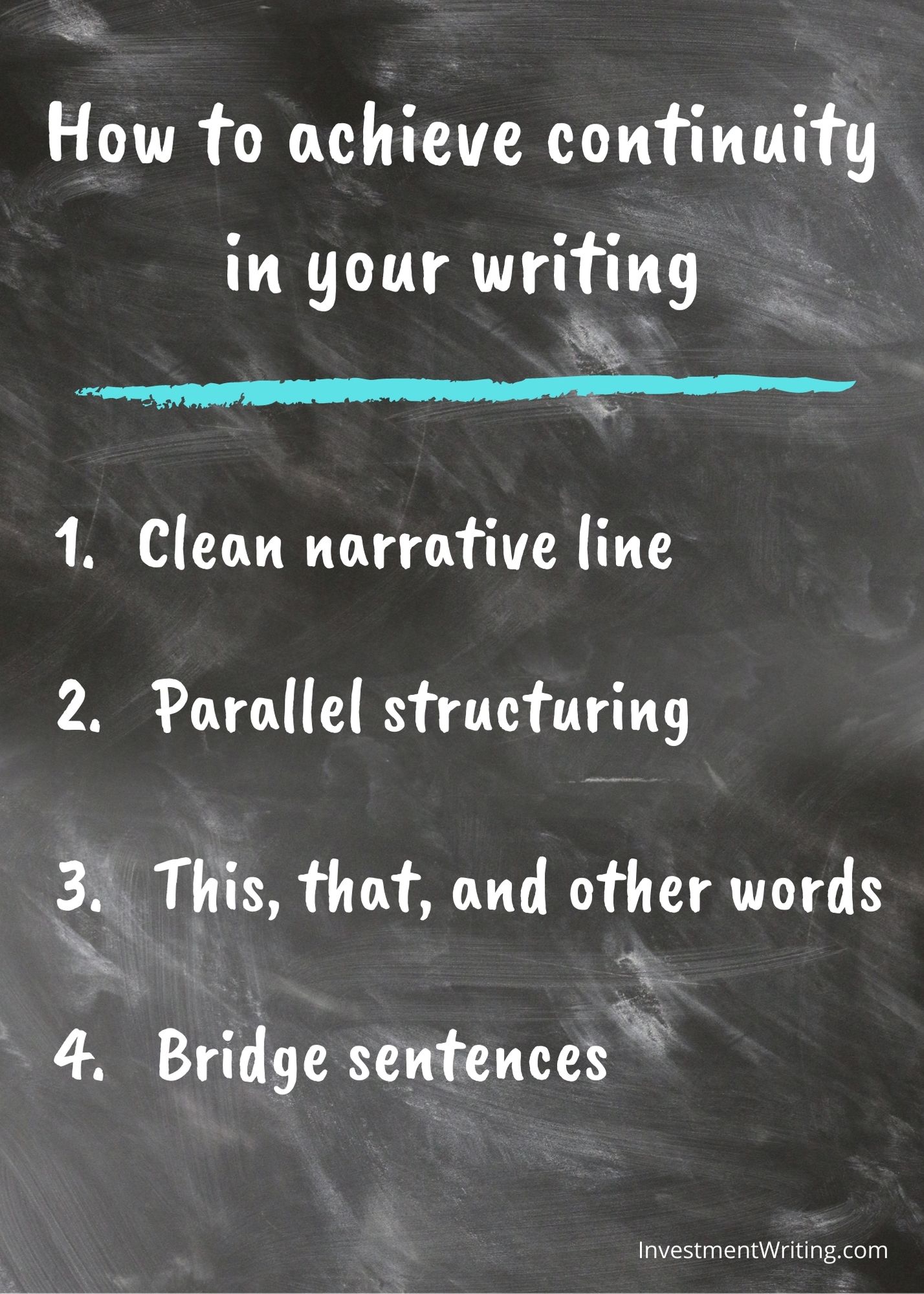
How to achieve continuity in your writing

1. Clean narrative line

Part of continuity is what Trimble calls “a clean narrative line. … Each sentence, each paragraph is hinged on the one that precedes it.”

As Trimble says, “When you know precisely where your essay has to go, you can ‘tell’ your argument as simply and coherently as if it were a story, which in a sense it is.” This is why, when I teach writing to financial professionals, I stress organizing your thoughts before you write. Financial Blogging: How to Write Powerful Posts That Attract Clients devotes an entire chapter to how to do this using mind mapping.

2. Parallel structuring

Still, there are other techniques you can use for continuity. Trimble mentions parallel structuring, which refers to:

the way paragraph 2 repeats the pattern of paragraph 1; the way each of those paragraphs ends with a key sentence; the way paragraphs 3-5 all begin alike; the way the closing paragraph looks back to the opening paragraph, and so forth.

Parallel structuring is not required. In fact, sometimes it is counterproductive when it’s forced or boring. However, it can sometimes help. Consider adding it to your writing tool kit.

3. This, that, and other words

Trimble recommends “the occasional repetition of key words” as well as “the careful use of pronouns such as this and that.” Those pronouns link to the preceding sentences.

Next, there’s the use of conjunctive adverbs or transitional phrases. Some are “bookish,” while others are conversational, like “in addition” versus “also.” Trimble lists many examples of these words that help “signpost” an argument.

4. Bridge sentences

Here’s another tip from Trimble: “View each paragraph opener as a bridge sentence aimed at smoothing our way into the new paragraph.” His illustration of the technique is very similar to what I suggest in my blog post discussing first-sentence checks.

Work at continuity

Continuity may not happen naturally. Trimble’s tips provide some tools to help you create continuity where it’s lacking.


Disclosure: If you click on an Amazon link in this post and then buy something, I will receive a small commission. I provide links to books only when I believe they have value for my readers.


The image in the upper left is by Gerd Altmann from Pixabay

Picture one person your work will help

Do you sometimes get stuck in the middle of writing something? Writer’s block and challenges with time When: the scientific secrets of perfect timing by Daniel Pinkmanagement are common problems. I found a tip that may help in When: the scientific secrets of perfect timing by Daniel Pink. The book discusses how to act at the right times, and how to overcome challenges at different points.

One person can help

One of Pink’s tips aims to help people who are stuck at a midpoint. “Picture one person who will benefit from your efforts. Dedicating your work to that person will deepen your dedication to your task,” he says.

I’ve met many advisors who struggle with completing blog posts, quarterly letters, or white papers. If you’re among them, would you feel more motivated to finish your blog post about 529 plans when you think about your meeting next week with the Millers, who want to help fund their grandchildren’s education? What if you think about a prospect with a highly concentrated stock portfolio, when you work on your white paper about diversification? Those thoughts would make a difference for me.

Added benefit for writers

Thinking of one person in your target audience is a doubly helpful tip for writers. Why? Because thinking about your reader will help you to write in a way that’s more reader-friendly than if your audience seems faceless to you. For example, you may remember that Jill Brown didn’t understand that technical term you used in explaining something to her.

More ways to overcome writer’s block

If you’re looking for more tips, here are my posts on managing writer’s block and distractions:

Your ideas?

How do you keep yourself moving when you feel stuck in a project? I’m always interested in learning from you.


Disclosure: If you click on the Amazon link in this post and then buy something, I will receive a small commission. I link only to books in which I find some value for my blog’s readers.


The image in the upper left is courtesy of Miklós Barabás [CC BY-SA 4.0]

4 tips for trimming extra words

Bryan Garner offers four tips for trimming extra words in his chapter “Waste no Words” in his HBR Guide to Better Business Writing.

They include, when possible:Bryan Garner: HBR Guide to Better Business Writing

For examples of how to trim extra words, see my posts on Word and phrase substitutions for economical writers and More substitutions for economical writers


Disclosure: If you click on the Amazon link in this post and then buy something, I will receive a small commission. I link only to books in which I find some value for my blog’s readers.


The image in the upper left is courtesy of Biswarup Ganguly  [CC BY 3.0]